Showing posts with label musicians. Show all posts

Monday, March 9, 2015

Little Melba and her Big Trombone

March 9 - Today's post contributed by Katheryn Russell-Brown


It was a Friday, late in the day, and I was at work. I was casually listening to the radio as I straightened up my office and prepared to leave.  The radio station featured a broadcast of “Melba Liston: The Bones of An Arranger.”  Initially what captured my attention was the narrator’s voice.  It was jazz singer Nancy Wilson.  I thought to myself, I don’t know who Melba Liston is but if the divine Ms. Wilson is moderating, she must be someone with noteworthy talents. As the show continued, I was taken with Melba’s life story, told through her music, her collaborators, and with snippets of her own voice. 
  
Melba was born in 1926, a time of great social change and unrest.  A new civil rights era was burgeoning, along with establishment of the nation’s first civil rights organization, the N.A.A.C.P.  It was also an era of lynch mobs, the recent passage of women’s suffrage, and the Great Depression was on the horizon.

I was intrigued by Melba’s story of joy, grit, determination, and pain.  Melba was born into a family of musicians and music lovers.  She enjoyed listening to songs on the radio.  In fact, at five-years old, she devised a written music code so she could remember the songs she heard.    At seven years old, it was love at first sight when she saw a trombone at the traveling music store.  She did not know anything about the awkward, large instrument but resolved to master it.  Melba was not deterred by the fact that the trombone was “not for girls.”  She knew she wanted to play it and play she did!  

With the support of her family, Melba kept pushing forward with her trombone, even when it was hard, uncomfortable, and lonely.  Even as a child, she was directing her musical future.  After Melba got her trombone, her mother arranged for her to have music lessons.  Melba met with the teacher but concluded that, “He wasn’t right.  I don't know how, but I knew. So I said ‘no,’ cancelled, and went on my own. I was always good in my ears, so I could play by ear.” 1 I love that Melba trusted her instincts—and at such a young age.

Melba’s well-honed talents and singular skills put her in high demand. Her musical collaborations were legendary.  She shared the bandstand with Dexter Gordon, Gerald Wilson, Dizzy Gillespie, Billie Holiday, and Quincy Jones.  She composed and arranged for Duke Ellington, Count Basie, Tony Bennett, Eddie Fisher, Billy Eckstine, the Supremes, Dinah Washington, Aretha Franklin, Ray Charles, Bob Marley, and Marvin Gaye.  Melba did arrangements on ten albums with jazz pianist Randy Weston.  

I was only able to scratch the surface of Melba Liston’s life in Little Melba and Her Big Trombone.  Many of Melba’s life lessons are ones that we can all learn from.  Here are a few:

Stay the course, though sometimes you may need to step off the road for a bit.  Melba loved music but sometimes the music world did not love her back.  Her extraordinary talents came with a high price.  She faced harsh treatment by some male musicians who viewed her as a threat.  At times she encountered blatant disrespect.  At other times, she  was simply ignored.  When traveling on the road, she was usually the only woman in the band.  She was expected to do women’s work, such as sewing buttons and cleaning up behind the men.  Even more troubling, she was assaulted by some of the men.  

Melba had a particularly difficult time when she went on a Southern tour with Billie Holiday’s band in the 1949.  Southern racism was rife and the crowds were sparse.  After the band ran out of money and disbanded, Melba put her trombone down.  She took a desk job at the Los Angeles School Board and won some small movie roles.  Melba played the harp in “The Prodigal” (1955) and was a member of the palace orchestra in “The Ten Commandments” (1956).  

Don’t accept other people’s limits on your talents.  From an early age, Melba knew she had a rare gift.  On a side note, one of Melba’s grade school teachers asked her mother for permission to adopt Melba so he could send her away to work with renowned music teachers.  Her mother said no.  

Melba was a perfectionist at all levels, beginning with writing and arranging music.  She was known to have exceptionally detailed, color-coded scores.  She outlined some material with red and blue pencils for emphasis.  She was very meticulous. 

Do something that brings you joy.  When Melba was perched on the bandstand, you could hear and feel her love for the trombone.  She wrote many songs.  One of her favorites was “Len Sirrah.”  Here’s a snippet (performed by Blue Mitchell): http://www.allmusic.com/album/the-complete-blue-note-blue-mitchell-sessions-1963-67-mw0000919651  

Melba Liston was a captivating trombone player.  To close, here she is performing with the Quincy Jones Band in 1960 in Switzerland:  https://www.youtube.com/watch?v=ojwANp_D_fE


I begin and end Little Melba and Her Big Trombone with, “Spread the Word! Melba Doretta Liston was something special.”  Indeed she was.

______________________

1  http://www.randyweston.info/randy-weston-sidemen-pages/melba-liston.html 


***

Katheryn Russell-Brown
Katheryn Russell-Brown is a Professor of Law and the Director of the Center for Race and Race Relations at the University of Florida. She grew up in a family of music lovers, where jazz was an integral part of the sounds of daily life. A radio broadcast in 2008 about Liston inspired Russell-Brown to research the musician and eventually to write Little Melba and Her Big Trombone, her first picture book. Russell-Brown lives in Gainesville, Florida, with her husband and their two children. She is from Oakland, California, by way of New York City.  Visit her online at krbrown.net .

Thursday, March 22, 2012

The Other Mozart

March 22 - Post provided by Elizabeth Rusch

The Other Mozart: With the right education could Maria Anna Mozart have rivaled her brother Wolfgang?


          "Virtuosic.” “A prodigy.” “Genius.” These words were written in the 1760s about a child musician who astounded the courts of Europe with artful performances. The name: Mozart.
Maria Anna Mozart.

Most people have heard of classical composer Wolfgang Amadeus Mozart and have listened to his music. But most don’t know that Wolfgang had a sister who was also a child prodigy. Fewer realize that she was a talented musician who toured internationally with her little brother for more than three years, performing for thousands of people in 88 cities. And almost no one knows these stunning facts:
* Maria Anna Mozart was thought to be a better pianist than Wolfgang.  “My little girl plays the most difficult works we have …with incredible precision and so excellently…” her father wrote in 1764. “What it all amounts to is this, that my little girl…is one of the most skillful players in Europe.”

* Maria Anna had a hand in some of Wolfgang’s compositions, literally. While on tour in the summer of 1764, Maria Anna sat down with Wolfgang, a quill pen, and paper and wrote a symphony. Symphony No. 1 in E-flat major is in Maria’s handwriting but is attributed to Wolfgang. 

* Maria Anna composed music of her own. At least one noted musician thought her compositions were brilliant.

Rome, July 7, 1770
My dear sister!
I am amazed to find how well you can compose. In a word, the song is beautiful…             
Wolfgang Mozart

Why would Wolfgang be amazed that his musically talented sister could compose so well?
Because she was never taught to compose music.
In honor of this year’s Women’s History Month theme of Women’s Education/Women’s Empowerment, I thought I would dig back into the research I did for my nonfiction picture book biography For the Love of Music: The Remarkable Story of Maria Anna Mozart (Random House/Tricycle, 2011) and explore what Wolfgang’s sister was taught and what she wasn’t taught and how that might have affected her place in history.
Maria Anna’s father Leopold Mozart was a court musician, so music filled her childhood home in Salzburg.  Leopold began teaching Maria Anna to play piano when she was 8 years old. She practiced for hours and progressed quickly, with 3-year-old Wolfgang often at her side.  Soon their father began teaching the two children together, but unlike Wolfgang, Maria Anna was never taught to play violin, organ, or to compose or improvise music. At the time, the education of a “Kapellmeister,” a court composer and musician, was thought inappropriate for a young woman. (Organ-playing, for instance, was considered unsuitable for women, because you had to move your legs around to push the pedals.)
Maria Anna was no doubt exposed to a rich musical world during the three years of the European tours. But in 1769, Maria was sidelined. Father and son departed for another tour, this time to Italy, the musical center of Europe, leaving Maria behind.
Why would this be? Some scholars guess that the family didn’t have enough money to tour both children. (Musicians had to take whatever payment was offered. Leopold once complained of having seven or eight gold watches and no money.) More likely, it was that Maria was at a marriageable age, while Wolfgang still had the cute factor as a child prodigy
From 1769 through 1771, while Wolfgang soaked up Italian operas, learned new instruments, and studied composition, Maria was stuck in Salzburg doing the shopping, making medicines, and sewing clothes. But she continued her musical development on her own, practicing, attending local concerts, and giving private performances. 
As Wolfgang later continued his grand European tours, Maria continued her work, accompanying her father each night by candlelight as he played violin. “To my amazement, [Maria Anna] has made such progress that she plays off at sight everything I bring back from the Cathedral however difficult…” Leopold reported to Wolfgang in 1778. “…she has acquired such perfect insight into harmony and modulations that not only can she move from one key to another, but she extemporizes so successfully that you would be astounded.”
If that’s what Maria Anna could accomplish on her own, imagine if she had been formally taught violin, organ playing, improvisation and composition and if she had been exposed to the rich musical worlds of Italy and Vienna. Could her genius have rivaled Wolfgang’s?
Many Wolfgang Mozart scholars would find even this question an abomination.  (Believe me, I know. I got quite a lot of push back when conducting interviews for an article for Smithsonian magazine on the question of how Maria Anna may have influenced Wolfgang musically. You can read the article here:  http://www.smithsonianmag.com/arts-culture/Maria-Anna-Mozart-The-Familys-First-Prodigy.html)
But given the evidence of Maria Anna’s talent and the severe limits of her education, the question is relevant. What did the world lose because Maria Anna Mozart’s education was limited by her gender? What masterpieces will we never hear? And what does the world lose today when the education of any young person is limited because of their gender? What do you think?


Elizabeth Rusch as Maria Anna Mozart


For further information:  A YouTube video of Elizabeth Rusch’s performance of Maria Mozart's life story can be viewed at: http://elizabethrusch.com/Appearances/MozartShow.aspx  Elizabeth Rusch offers a free curriculum guide for For the Love of Music, which includes creative art projects, hands-on musical games, and engaging history lessons for elementary and middle school students.  It features lessons on mapping the Mozart's musical tour of Europe, explorations of how Maria Anna Mozart's life would be different if she had been alive today, an exercise where students link primary source letters written by the Mozart family and friends to scenes in For the Love of Music, and more. You can find it at:  http://elizabethrusch.com/MyBooks/AllBooks/FortheLoveofMusic/FortheLoveofMusicCoolStuff.aspx   You can book Elizabeth Rusch for a performance or for school visits through her website at www.elizabethrusch.com.

Editor's Note:  Elizabeth Rusch is an award-winning magazine writer and children's book author. She writes both fiction and nonfiction in the areas of science, art, sports, waves, jokes, crayons, and mud — anything that catches her fancy.  

If you'd like to win a copy of this book, along with an assortment of other books on women's history, please leave a comment below.  Each comment that you submit this month on this blog will give you an entry to win this prize pack of seven women's history picture books for your library, classroom, or personal collection!


Tuesday, March 20, 2012

Red Bird Sings: The Story of Zitkala-Sa and Book Giveaway!

March 20 - Today's post provided by Gina Capaldi


Twenty some odd years ago, I came across the work of Gertrude Simmons Bonnin, Native American author and musician. Published by the Atlantic Monthly Magazine in 1900, her serialized stories appeared under the pen name, Zitkala Sa. To this day they captivate me as none other.  Her tales are of a young girl who was sent from her home on the Yankton Reservation to attend a Quaker boarding school. After graduating from college she become a teacher, and finally an author. The experiences Zitkala Sa shared about her passage from Yankton life to Anglo society were often as heart wrenching as they were riveting. It was not, however, until I began researching another book, A Boy Named Beckoning: the True Story of Dr. Carlos Montezuma (Lerner/Carolrhoda, 2009), that I was reminded of Gertrude Simmons Bonnin, not as Zitkala Sa, but as a young woman in love with a Yavapai doctor and activist.

Gertrude Bonnin


Following this tidbit of information, I discovered that Zitkala Sa as the first American Indian to write an opera, and that she was also a powerful activist who championed the rights of her people.  The opportunity to write and publish a story about Gertrude Simmons Bonnin came along when Jean Reynolds, my editor for A Boy Named Beckoning, asked if I was familiar with Zitkala Sa. Was I ever!
The possibility of writing a picturebook encouraged me to recruit my co-author, Q. L. Pearce. Her knowledge and passion about Native American cultures, her divine writing gift, attention to detail, and consummate professionalism helped to bring the manuscript to fruition. By the end of 2009 Q and I were steeped in research searching for the full, rich details of Gertrude Simmons’ life that would enable us to create the picturebook, Red Bird Sings: The Story of Zitkala Sa (Lerner/Carolrhoda, 2010). 
We used several of Gertrude’s serialized stories from the Atlantic Monthly Magazine  (Impressions of an Indian Childhood, The School Days of an Indian Girl, and An Indian Teacher Among Indians) to build the framework for our picturebook.  We discovered that she had not intended her stories to merely entertain but to enlighten Anglo society. Writing as Zitkala-Sa (Red Bird), she presented her readers with thought provoking and often disturbing snapshots of her life, and that of other Native Americans trapped in the massive experiment of American Indian assimilation and its consequences. Many historians believe, however, that Gertrude’s stories were only semi-autobiographical and not entirely factual.

Our goal was to tell the true story of Gertrude's life so we set about weeding through the misinformation and confirming the facts through scholarship. We began our research at Brigham Young University, Marriott Library, which houses the Gertrude and Raymond Simmons archives. From these we were able to outline Gertrude's life on the Ute Reservation, her family life, her work on the Sundance Opera and her collaboration with another musician, William Hansen. We also discovered the depth of her personal commitment to her people that inspired her activism from Utah to Washington, DC.  From the Carlisle Indian Industrial School Archives, we were able to chronicle Gertrude's association with the school before and after teaching. The information garnered from these archives also revealed how she began to write her Atlantic Monthly series, and how the stories were viewed by her employer, Captain Richard Pratt.  We also approached Earlham College librarians who generously supplied us with massive copies of articles, report cards, writings published in their school newspaper, and much more. It was a tremendous amount of information to go through, but each document helped us to weave the story of Gertrude's life. Finally, we looked to individual historians who generously helped us fill in the missing details and identify any misinformation about Gertrude Simmons Bonnin.

Our second hurdle was what to choose which of Gertrude’s stories could best represent her point of view in a 32-page picturebook.  She wrote in the late 1800's and was published in the first part of the 20th century. Her stunning prose is dense and her language may be difficult for a young reader. Hoping to simplify the style while maintaining the spirit of Zitkala Sa’s work, we chose to modernize her language enough to make it more accessible to a young audience and so introduce them to her powerful story.


We used the images in the book to give readers a further sense of the time and place in which Gertrude lived. By incorporating collage elements we were able to add historical and emotional depth. For example, newspaper clippings and maps added historical information, and pressed flowers and grasses native to Gertrude’s homeland expanded the sense of setting. Perhaps one of the most profound collage elements was our use of real hair in the cover and leading page images.  In Gertrude’s culture shorn locks were a sign of mourning or cowardice. The dramatic cutting of her hair caused Gertrude to experience fear, humiliation and shame. The reality of the clipped hair in the art added to the drama of the spread.


Overall, the life of Gertrude Simmons Bonnin is one of bravery, determination and devotion. In spite of the loss, discrimination and self-doubt she faced, she succeeded and went on to fight for her people. Red Bird Sings is an American Indian story and the story of a woman whose great courage enabled her to reach a global audience and bring about change for those suffering in an oppressive system. We are proud to be a part of bringing that story to a new generation of young readers.

Giveaway:  Would you like to win an autographed copy of Red Bird Sings?  If so, please leave a comment below!  The winner will be chosen at random.  

Editor's Note:  Gina Capaldi has both written and illustrated award-winning books that include nonfiction, educational and picture books, including A Boy Named Beckoning: The True Story of Dr. Carlos Montezuma, Native American Hero (Carolrhoda/Lerner, 2008).  She is also a certified fine arts appraiser and has honed her other professional arts skills with credits in film editing and video graphics.   She has previously worked as an illustrator, product developer and designer for an international manufacturing company.


Monday, March 21, 2011

Women of Color Make Their Presence Known

March 21 - Today's post provided by TheHappyNappyBookseller
 
I loved the movie A League of Their Own, directed by Penny Marshall. The story is inspired by the All American Girls Professional Baseball League. It's been years since I've seen it but I still remember a lot of it.  Geena Davis was fearless behind the plate, and of course the now classic scene of Tom Hanks screaming, "there's no crying in baseball."

Another smaller scene I will never forget is when the players are practicing and a ball gets away from Madonna and Rosie O'Donnell's characters.  On the other side of the fence three Black woman are walking past. When asked to return the ball, one of the woman just guns it back.  All the women just stare at each other for a blink of a second.  The Black woman is clearly good enough to play but can't because of her race.   

The Voice that Challenged a Nation: Marian Anderson and the Struggle for Equal Rights, by Russell Freedman, the story of singer Marian Anderson, broke my heart.  Anderson was rejected many times because of either race or gender. 

It's not lost on me that both examples I've given feature Black women.  It's second nature for people to focus on what they feel most connected to.  The trick is to recognize this and make a conscious  effort to think outside of yourself.            

One book I discovered last March was Amelia to Zora: Twenty-six Women who Changed the World, by Chin- Lee Megan, illustrated by Halsey Sean Addy.  A few of the women featured are Babe Didrikson Zaharias, an athlete that excelled at every sport she played; Cecilia Payne Gaposchkin, an astronomer and the first female professor at Harvard University; Nawal El Sadaawi a doctor and fighter for woman's rights; Grace Hopper inventor and computer pioneer; Vijaya Lakshmi Pandit -an Indian diplomat and the first woman president of the United Nations.   I love that the woman included are as diverse as their accomplishments. 

 It's no secret Women of Color  face more obstacles in life and I am always moved by their stories.  Below are a few of the ones I've loved.   

Shining Star: The Anna May Wong Story by Paula Yoo, illustrated by Lin Wang- The first Asian movie star in Hollywood. If you get a chance watch this great interview with the author.


The Little Piano Girl : The Story of Mary Lou Williams by Ann Ingalls and MaryAnn Macdonald, illustrated by Giselle Potter -  Not only was Mary Lou Williams a jazz pianist she was also a  composer and arranger.  In the afterword there is a Duke Ellington quote - "Mary's music retains a standard of quality that is timeless. She is like soul on soul."

In Her Hands: The Story of Sculptor Augusta Savage by Alan Schroder,  illustrated by JaeMe Bereal - Augusta Savage was one of the primary artists of the Harlem Renaissance. Thanks to this biography I know that Savage created  a sculpture for the 1939 World's Fair in New York, "The Harp."

She Loved Baseball by Audrey Vernick, illustrated by Don Tate. The story of Effa Manley, co-owner of the Brooklyn Eagles, a Negro League Baseball team. Manley is the first woman to be inducted into the National Baseball Hall of Fame. 

Skit Scat Raggedy Cat : Ella Fitzgerald by Roxanne Orgill, illustrated by Sean Qualls.  We get a whole lot of Ella. Perfect for anyone who loves Fitzgerald's music and for those who are not familiar with her work.   

Sky High: The True Story of Maggie Gee by Marissa Moss, illustrated by Carl Angel - One of only two Chinese American women to serve in Women Airforce Service Pilots (WASP) program during WWII. Moss includes some wonderful photographs in the back, including one of Maggie in her uniform and Maggie's mother building Liberty ships, hardhat and all.
    
Side by Side/Lado a Lado by Monica Brown,  illustrated by Joe Cepeda- Dolores Huerta is an activist and co founder of National Farmers Workers Association with Cesar Chavez. There are a few children's biographies on Cesar Chavez, although as far as I know this is the first one that pertains to Dolores Huerta.

Seeds of Change: Wangari's Gift to the World by Jen Cullerton Johnson, illustrated by Sonia Lynn Sadler-  This is my favorite children's biography on Wangari Maathai. My interview with the author can be found here. 


Sonia Sotomayor: A Judge Grows in  the Bronx by Jonah Winter, illustrated by Edel Rodriquez - A timely biography on the first Latina judge to serve on the Supreme Court.  

I did my best to place the biographies in a timeline order. This last one should be somewhere in the middle but I felt its gender and racial unity made it the perfect book to end with.  

The Sweethearts of Rhythm: The Story of the Greatest All-girl Swing Band in the World by Marilyn Nelson, illustrated by Jerry Pinkney - The Sweethearts of Rhythm was the first integrated all women swing band in the world. When formed in 1937 the band included a Chinese saxophonist, a Hawaiian trumpeter and a Mexican clarinetist, along with Black musicians. In 1943, White musicians join the band for the first time.  

All of these women refused to let anyone deny them their rightful place in history.  Knowing what all they have accomplished in spite of everything fulls me with so much joy.  All of these biographies make sure their contributions, successes and sacrifices are not forgotten. 

Editor's Note:
TheHappyNappyBookseller is a bookseller and baseball fan in Atlanta Georgia.
Author Audrey Vernick, mentioned above, has shared her experience of writing She Loved Baseball in an earlier post.

Monday, March 14, 2011

Women Who Followed Their Musical Dreams

March 14 - Today's post provided by Holly George-Warren
I originally interviewed Loretta Lynn for
Rolling Stone Magazine in 1994.


I bought Loretta Lynn’s cookbook
 at her recent concert.
I just participated in the celebration of Loretta Lynn’s golden anniversary as a country music performer: She and her band the Coal Miners performed in a beautiful old theater in upstate New York, as part of her 50th Anniversary Tour. At age 77, Loretta can still sing with power, and onstage she’s quite a pistol. Five decades ago, when she started her career with “Honky Tonk Girl,” a song she wrote and recorded for a small label, women performers were scarce in country music. In those days, record companies had the misconception that women, the primary record buyers at the time, only wanted to purchase discs by handsome male singers. Were they ever wrong! Loretta, then a young mother with four children (and later two more), proved that songs written from a woman’s point of view could be big-sellers. In 1961, she was inspired by the few female country artists, especially Kitty Wells and Patsy Cline, who became stars by singing tunes penned by others. Not only could Loretta relate her experiences as a wife and mother by writing her own material, but she could make more money that way as well. She knew what it was like to be poor, growing up in a large family in Kentucky, with her father eking out a living as a coal miner. One of Loretta’s best songs, “Coal Miner’s Daughter,” tells the story of her life. Without Loretta paving the way, there would be no Carrie Underwood or Taylor Swift.


I interviewed Dale Evans, the Queen of the West, in 1999.
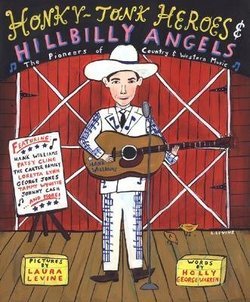
 I’ve been lucky to interview Loretta, as well as Kitty Wells, and another fantastic country singer, Tammy Wynette. All of them are featured in my book, Honky-Tonk Heroes and Hillbilly Angels: The Pioneers of Country & Western Music.  These women were also inspired by some of America’s first women entertainers: cowgirls. Singing cowgirls Patsy Montana and Dale Evans both had successful careers onstage, making records, and in the movies. When they started performing in the 1930s, it was frowned upon for women to travel alone, much less have a career in show business. Patsy, who was born Ruby Blevins in Arkansas, and Dale, born Lucille Smith in Texas, changed their names to become stars, first by performing on the radio. By taking on the image of the cowgirl, they portrayed independent gals who were headstrong and courageous. Their forebears were mothers and daughters who actually traveled west in the late 1800s and became experienced equestriennes. Some of these women joined Wild West shows and early rodeos to entertain audiences with their skills on horseback. I met both Dale Evans and Patsy Montana before they passed away, and they inspired me to tell their stories – and the history of women of the West – in my book, The Cowgirl Way. Another Western trailblazer who started her career dressed as a cowgirl is Wanda Jackson, the Queen of Rockabilly. She grew up in Oklahoma and had her own radio show when she was only thirteen. While still in high school, she made her first record and had a country hit. But in 1954, on tour with Elvis Presley, Wanda fell in love with rock & roll and started singing rockin’ numbers like “Let’s Have a Party,” “Fujiyama Mama,” and “Hard-Headed Woman.”  I have seen Wanda, who’s now 73, perform all over the United States and she always thrills audiences – because she loves what she’s doing and is such a dynamo onstage.

Wanda Jackson joined me at my book signing at Yard Dog in Austin, Texas for
 Shake, Rattle & Roll in 2002 .
Wanda is featured in my book, Shake, Rattle & Roll: The Founders of Rock & Roll. Her new album, The Party Ain’t Over, recorded with Jack White (known for his band the White Stripes), has been getting rave reviews in such publications as the New York Times and Rolling Stone. Let’s hope a whole new generation of music fans will discover her high-octane sound! I once asked Wanda about her influence as an artist, and she said, “Through the years many girl artists have told me some really wonderful stories about how they got into music, and many times I played a major role in at least giving them the courage to do the music they felt in their soul – just the way I did.  And it’s always gratifying when you feel like you’ve influenced someone to follow her own dreams.”

Editor's Note:
Holly George-Warren is an award-winning writer, editor, book packager, producer, and music consultant.  Her music, writing, consulting and appearance credits are almost too numerous to mention! Visit her site at http://www.hollygeorgewarren.com/

Tuesday, March 8, 2011

Cleopatra Confesses

March 8 - Today's post provided by Carolyn Meyer

For the past 20 years I have been writing novels about women—some famous (Mary, Elizabeth, Anne Boleyn--all those Tudor queens!), some not so famous (Mozart’s sister, Shakespeare’s wife)—and their place in history. What has fascinated me in every case is not who they became, which is why we recognize their names and want to read about them, but who they were when they were young. I am familiar with the myths. Consider Marie-Antoinette, for example—a terrible, selfish queen who regularly sent innocent people off to the guillotine while cruelly dismissing the starving French people with that famous line, “Let them eat cake!” Right?
            Wrong.
            She never said it. Furthermore, Marie-Antoinette was not responsible for anyone’s execution. Although it’s true that she was naïve and insensitive to the harsh conditions under which the common people lived, and that she spent way too much money on gorgeous clothes and fabulous gardens and pleasure houses, she was not a monster. Far from it.
            Marie-Antoinette was once a frightened child who could not please her stern mother, at fourteen sent far from home to marry a boy she’d never met, then criticized and manipulated by older women who resented her and were determined to bring about her downfall.

            This young and vulnerable princess was the Marie-Antoinette in whom I was willing and eager to invest over a year of intense research (OK, there was a trip to Paris, so the research wasn’t all grueling), and of writing and rewriting THE BAD QUEEN.

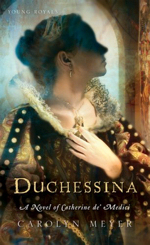
            Consider, too, Catherine de’ Medici, who has still not lived down her reputation for mercilessness, but when you examine her family, including a dastardly cousin and her uncle the pope who sent her off, another 14-year-old, to marry a man who could not bring himself to sleep with her, it’s easier to understand her complex personality. DUCHESSINA is my attempt to show another Catherine behind the one we love to hate. (Besides, Italy is a lovely place to visit.)
            Although many of my books have been about queens, I have sometimes become caught up in the lives of less exalted creatures. Anne Hathaway was eight years older than that young scamp, Will Shakespeare, but she succumbed to his charms, poetic and otherwise, and long before Will the glove-maker became SHAKESPEARE, the rich and famous playwright, they were married. I regret to say that it was not the happiest of marriages. Anne narrates their story in LOVING WILL SHAKESPEARE, and through her we get to know quite a lot about him. (Stratford-upon-Avon, the English village where they grew up, is a charming place to explore.)
            Many readers are surprised to learn that Wolfgang Amadeus Mozart, the musical genius, had a talented older sister, Nannerl. But Nannerl had everything going against her: women of her era were not permitted careers as pianists, no matter how accomplished; her domineering father poured all the Mozart family resources into promoting his bratty, brilliant son—and to make matters worse, forced Nannerl into marriage to a man she didn’t love. I wrote IN MOZART’S SHADOW to allow her to tell her own story and to give her the attention she deserves.
            I have explored the early lives of a dozen other women in history who have been loved or hated, misunderstood or ignored, and always I have focused on them as very young women. My latest novel, CLEOPATRA CONFESSES, is finally finished (and I confess that a trip to Egypt with a Nile cruise was part of the research). Unlike Marie-Antoinette and Nannerl Mozart, about whom much material is easily available to even the laziest researcher, Cleopatra remains a mystery. Images of Elizabeth Taylor in a movie version of the Egyptian queen’s story still float around in my head. Many have heard the tale of Cleopatra being delivered to Julius Caesar wrapped in a rug (it’s true), and much has been written about her affair with Mark Anthony. (Shakespeare wrote a play about the lovers.) But what must it have been like for her as a little princess, growing up in a palace in Alexandria, desperately trying to avoid her jealous older sisters while her father journeyed far from home?  How did she manage to survive in a culture where family members plotted against each other as they strove for power and wealth?

Cleopatra tells her own story in the novel to be published in June.

Editors Note:
Find out more about Carolyn Meyer at her website. the site features information on her many best-selling books, school visit information, tips for writers, biographical information, and much more!