March 11 - Today's post contributed by Mia Wenjen
Anna May Wong faced bullying and racism as an Asian American who sought a Hollywood film career in the 1920's. You may have never heard of her; she's new to me too, but she paved the way for Asian American actors who still today face discrimination, stereotyping and limited roles in Hollywood on screens both big and small!
.jpg) |
| Anna May Wong (passport style photograph) Used on official U.S. document sometime between 16/12/1935 to 1/2/1936. The photograph may have been taken earlier than this. National Archives and Records Administration |
 |
| By A. Ranguelov (Own work) [Public domain], via Wikimedia Commons |
 |
| [Portrait of Anna May Wong] Van Vechten, Carl, 1880-1964, photographer 1935 Sept. 22 Library of Congress Prints and Photographs Division |
She's considered the first Chinese American movie star, and the first Asian American actress to gain international recognition. Her long and varied career spanned both silent and sound film, television, stage and radio.
 |
[Portrait of Anna May Wong]
Van Vechten, Carl, 1880-1964, photographer
1932 Apr. 20Library of Congress Prints and Photographs Division |
I discovered her through Paula Yoo while covering her picture book on micro loan creator Muhammad Yunnis.
Shining Star: The Anna May Wong Story by Paula Yoo, illustrated by Lin Wang
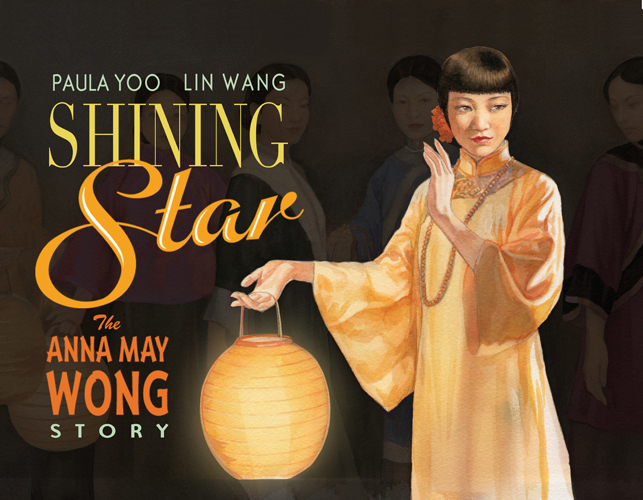
With limited choices, Anna took what little roles were offered to her, even ones that used yellow face or portrayed demeaning images of Asians. In 1929, her role in Piccadilly make her a star ... in Europe (not America)! Disenchanted with the racism she faced in America, she decided to go to China where her father now lived and vowed never to take roles where Asians were shown in an unsympathetic light -- a brave decision given the dearth of roles.
As an Asian American actress, Anna May Wong fought and broke through barriers erected and still remaining in Hollywood. She's a role model to be celebrated for Women's History Month.
Here's author Paula Yoo with more insight on what Anna May Wong faced:
.jpg)
Like Josephine Baker, Anna May Wong's breakout success happened in Europe. Why do you think Europeans were more open to people of color than Americans given that Europe is more homogeneous?
PAULA:
Europe is not as homogeneous as people think - even for back then. There were many diverse people living in Europe at the time. However, I think part of the problem was that Chinese American history was fraught with great racism. Many Chinese emigrated to America to help build our first railroads. Their presence was met with much suspicion and prejudice. So those roots did not help Asian American actors in Hollywood who were already dealing with an institutionalized and deep-seated systemic discrimination already set in place. Europe did not have that history, so they did not have the same “baggage” that existed in America. Anna May Wong’s widely publicized friendship with German actress and international star Marlene Dietrich also helped Europe’s acceptance of her. Now, despite this acceptance, Anna May Wong was still viewed as “exotic” and “different.” So prejudice still against Asians existed overseas, but it was not as overt as in America… at least for what Anna May Wong experienced. Interestingly enough, I recently read an article that talked about a new trend of Asian American actors moving to Asia to kick start their careers because it’s still difficult for Asian American actors to get cast in parts in Hollywood. Link here.
And that's exactly what Bruce Lee had to do in order to break into Hollywood: return to Asia, write/film/direct his own movies, and become an Asian superstar in order for Hollywood to accept him.
What impact do you think Anna May Wong had in history?
PAULA:
Anna May Wong has had an incredible impact on our cultural history. She was one of the first Asian American movie stars in the industry. Despite all the racial prejudice against her, she managed to rise above it with her talent and determination. It is actors like Anna May Wong who paved the way for today’s Asian American actors to be taken seriously and with respect. As for the controversy over Anna May Wong’s roles which were viewed as demeaning to Asian Americans, there’s a famous saying about how our older generation of actors had to go through the back door of the house so today’s actors could walk through the front door. I think today’s younger Asian American actors understand and appreciate the sacrifices and struggles their older generation of actors had to endure so they could have an easier journey today.
What in the one message you want readers learn about Anna May Wong?
PAULA:
I would like readers to walk away with the knowledge that Anna May Wong was a pioneer whose true talent and persistence was what enabled her to be successful. At the end of the day, no matter what obstacles you run into, you must believe in yourself and work hard at your gifts and talents to overcome those barriers. In the end, true talent rises above all those obstacles.
How do you feel about old musicals, films and theater performances etc. that portray Anti-Asian stereotypes like the submissive "China Doll" and the domineering Dragon Lady being shown or performed today? They cite historical reference as their justification for its relevance.
PAULA:
I’m aware of this controversy. Although academically I can understand the argument for historical reference, I feel at the end of the day that this is a lazy defense. We already are well aware of the “historical reference.” It’s too easy and too simple of an excuse. Now, I’m NOT in favor of censoring anything, of course. We should never deny the unpleasant parts of our cultural history. But I believe there could be more sophisticated ways to “re-boot” these images in a clever and satirical context. I know people have good intentions, but when it comes to dealing with “classic” racist roles, unfortunately it seems as if folks are too willing to engage in what is known as “first thought theatre” and just doing a mediocre and on-the-nose interpretation instead of really digging deep and trying to come up with something much more sophisticated. I’m all for lampooning these roles, but the satire has to be very sharp for that to work. It’s already a dangerous minefield to begin with, so if you’re going to do it, then embrace it and go beyond the obvious interpretation. And I feel some of these controversies have arisen because the attempts to satirize these “classic” racist roles have fallen flat because the satire was not sharp enough. Finally, given that we haven’t progressed as far as we should have in terms of Asian American positive and realistic/authentic imagery in the media, why continue to dig up the older images when we haven’t made enough NEW images to balance things out? Let’s focus on building a better future first before examining our past, which still outweighs what’s happening in the present.
Thank you Paula for bringing attention to Anna May Wong, America's first Asian American movie star!