Showing posts with label Cleopatra. Show all posts

Tuesday, March 13, 2012

Ancient Queens and Modern "Sluts"

March 13 - Today's post provided by Vicky Alvear Shecter


Ancient Queens and Modern “Sluts”
 
When a popular talk-radio host recently called a female law student a “slut” for disagreeing with his politics, my first thought was, “Here we go again.”

There is a long history of people in power using sexually demeaning labels to undermine or silence strong women. Why? Because, often, it works. In fact, I discovered—in researching my mid-grade biography, Cleopatra Rules! The Amazing Life of the Original Teen Queen—that Romans used that very tactic to whip up fear and loathing against the queen of Egypt.

Most modern scholars believe that Cleopatra VII only had two relationships her whole life—first with Julius Caesar then, years later, with Mark Antony. The queen allied herself with these powerful Romans in a bid to protect her kingdom’s independence.  And she fought to maintain and protect those alliances to the bitter end.

In, Cleopatra’s Moon, my YA novel about the queen’s daughter Selene (the only one of the queen’s four children to survive to adulthood), the teen princess is taken aback by the vitriol aimed at her mother. How could they call her a whore, she wonders, when her mother was so clearly loyal to Selene’s father, Mark Antony? So loyal, in fact, that when their enemy offered the queen continued rule of her kingdom if only she turned over or killed Antony for him, the queen refused.  Multiple times.

The real Cleopatra, modern scholars are learning, is very different from the one Hollywood has tried to jam down our throats. She was not, for example, beautiful; she may well have been quite ordinary-looking. (Meanwhile, Hollywood has cast the gorgeous Angelina Jolie to play her in an upcoming production!)

The real Cleopatra was a powerful woman known for her intelligence, political acumen and ability to speak more than seven languages. She wrote books, sponsored mathematical salons at the Library of Alexandra, and encouraged scientific innovations.

So how did this brilliant ruler end up smeared as “man-eating, whore-queen?” Her enemy, Octavian (later called Augustus), waged a propaganda war against the queen so effective, we still feel the echoes of it today.

            He created a frenzy of fear and hatred for her in Rome by claiming that Cleopatra sexually enslaved Mark Antony, “drugged” him, and so “bewitched” and “unmanned” him, that he could no longer be held responsible for his actions. In other words, any problem he himself had with Mark Antony had to be her fault.

            And so he declared war on her.

When I speak to teens today about how Cleopatra’s image was manipulated by her enemies, I often ask them what they call girls they don’t like or who intimidate them in some way.  They usually end up smiling sheepishly. Because, if they are honest, they admit that they have also used the insults. Or have been hurt by them.

History gives us neutral territory to discuss touchy issues that affect us today. It allows us to pause and ask, “Wait. Why are we still doing this?”

And, hopefully, start changing things once and for all.


Editor's Note:
Vicky Alvear Shecter is the author of the young adult novel, Cleopatra’s Moon (Arthur A. Levine/Scholastic) and the author of two mid-grade biographies: Alexander the Great Rocks the World and Cleopatra Rules! The Amazing Life of the Original Teen Queen.


Tuesday, March 8, 2011

Cleopatra Confesses

March 8 - Today's post provided by Carolyn Meyer

For the past 20 years I have been writing novels about women—some famous (Mary, Elizabeth, Anne Boleyn--all those Tudor queens!), some not so famous (Mozart’s sister, Shakespeare’s wife)—and their place in history. What has fascinated me in every case is not who they became, which is why we recognize their names and want to read about them, but who they were when they were young. I am familiar with the myths. Consider Marie-Antoinette, for example—a terrible, selfish queen who regularly sent innocent people off to the guillotine while cruelly dismissing the starving French people with that famous line, “Let them eat cake!” Right?
            Wrong.
            She never said it. Furthermore, Marie-Antoinette was not responsible for anyone’s execution. Although it’s true that she was naïve and insensitive to the harsh conditions under which the common people lived, and that she spent way too much money on gorgeous clothes and fabulous gardens and pleasure houses, she was not a monster. Far from it.
            Marie-Antoinette was once a frightened child who could not please her stern mother, at fourteen sent far from home to marry a boy she’d never met, then criticized and manipulated by older women who resented her and were determined to bring about her downfall.

            This young and vulnerable princess was the Marie-Antoinette in whom I was willing and eager to invest over a year of intense research (OK, there was a trip to Paris, so the research wasn’t all grueling), and of writing and rewriting THE BAD QUEEN.

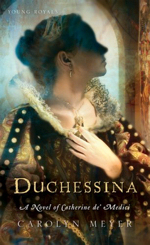
            Consider, too, Catherine de’ Medici, who has still not lived down her reputation for mercilessness, but when you examine her family, including a dastardly cousin and her uncle the pope who sent her off, another 14-year-old, to marry a man who could not bring himself to sleep with her, it’s easier to understand her complex personality. DUCHESSINA is my attempt to show another Catherine behind the one we love to hate. (Besides, Italy is a lovely place to visit.)
            Although many of my books have been about queens, I have sometimes become caught up in the lives of less exalted creatures. Anne Hathaway was eight years older than that young scamp, Will Shakespeare, but she succumbed to his charms, poetic and otherwise, and long before Will the glove-maker became SHAKESPEARE, the rich and famous playwright, they were married. I regret to say that it was not the happiest of marriages. Anne narrates their story in LOVING WILL SHAKESPEARE, and through her we get to know quite a lot about him. (Stratford-upon-Avon, the English village where they grew up, is a charming place to explore.)
            Many readers are surprised to learn that Wolfgang Amadeus Mozart, the musical genius, had a talented older sister, Nannerl. But Nannerl had everything going against her: women of her era were not permitted careers as pianists, no matter how accomplished; her domineering father poured all the Mozart family resources into promoting his bratty, brilliant son—and to make matters worse, forced Nannerl into marriage to a man she didn’t love. I wrote IN MOZART’S SHADOW to allow her to tell her own story and to give her the attention she deserves.
            I have explored the early lives of a dozen other women in history who have been loved or hated, misunderstood or ignored, and always I have focused on them as very young women. My latest novel, CLEOPATRA CONFESSES, is finally finished (and I confess that a trip to Egypt with a Nile cruise was part of the research). Unlike Marie-Antoinette and Nannerl Mozart, about whom much material is easily available to even the laziest researcher, Cleopatra remains a mystery. Images of Elizabeth Taylor in a movie version of the Egyptian queen’s story still float around in my head. Many have heard the tale of Cleopatra being delivered to Julius Caesar wrapped in a rug (it’s true), and much has been written about her affair with Mark Anthony. (Shakespeare wrote a play about the lovers.) But what must it have been like for her as a little princess, growing up in a palace in Alexandria, desperately trying to avoid her jealous older sisters while her father journeyed far from home?  How did she manage to survive in a culture where family members plotted against each other as they strove for power and wealth?

Cleopatra tells her own story in the novel to be published in June.

Editors Note:
Find out more about Carolyn Meyer at her website. the site features information on her many best-selling books, school visit information, tips for writers, biographical information, and much more!