Showing posts with label inventors. Show all posts

Thursday, March 21, 2013

Women Invent!

March 21 - Today's post provided by Susan Casey


Shortly after starting to research and write Women Invent! Two Centuries of Discoveries That Have Shaped Our World, I realized I was entering a world I wouldn't be able to easily exit.  As I read about Harriet Irwin, mother of nine, yes, nine, who in 1869 was the first woman in the US to patent an architectural innovation--a hexagonal house that eliminated sharp corners that are difficult to dust and clean--I was captivated.

 Then, I discovered Mary Nolan had gained a patent for Nolanum--a hollow, fireproof, interlocking brick that could be used to make walls without plaster.

 And I read that Rose Totino had invented frozen pizza!  I could hardly contain my enthusiasm as I read about inventor after women inventor.  And looking at their patents?  Wow!  Such amazing images.  I suspected that most girls didn't know their stories.  I hoped by relating them I could inspire girls to embrace and act on their own ideas.  For example, In 1843 Nancy Johnson patented the first hand-crank ice cream maker.  Who doesn't like ice cream?  Couldn't a girl be inspired to think of an invention related to her favorite food?


Bertha Dlugi wanted her parakeets to have the experience of flying freely around her house but she didn't want to clean up after them.  So she invented Diapers for Parakeets in 1959!  Such a funny idea but in relating the story couldn't I inspire a girl to invent something for her pet?


It was the captivating stories and the chance to inspire young girls that propelled me as I wrote the book.  Some of the stories of women inventors might encourage the creativity of girls you know.  Here are a few:

Martha Coston
Martha Coston of Philadelphia was only 21 in 1847 when her husband, Benjamin, an inventor for the Navy, unexpectedly died of pneumonia.  Alone, it was up to Coston to support herself and her four small children.  Her invention efforts began when she found a notebook with her husband’s ideas for signal flares.  He thought they could be used to communicate ship-to-ship or ship-to-land. But when she tested the models he had created they didn’t work. She kept at it, found a solution and in 1859, just before the Civil War, she patented a system of red, white and green “Pyrotechnic Night Signals.” The U.S. Navy bought the rights to the signals for $20,000 and awarded her the contract to manufacture them.

Carlotta Myers
Carlotta "Queen of the Air" Myers and her husband, Carl, were fascinated with hydrogen gas balloons.  They staged demonstrations to support their research and gained a patent for guiding them. Carlotta made her first flight on July 4, 1880, at Little Falls, New York, as fifteen thousand people watched. Her companions were four carrier pigeons that she released to alert friends of her progress.


Amanda Jones
Amanda Jones was trying to communicate with her dead brother at a séance, when she claims she was told by her spiritual guide to become an inventor.  Lucky for us.  She and her cousin, Leroy J. Cooley, devised a vacuum process for preserving food.  She started the Women’s Canning and Preserving Company in the 1890s and sold the ‘canned food’ nationwide.

Josephine Cochran 
Josephine Cochran, inventor and entrepreneur, not only gained an 1886 patent for the first practical mechanical dishwasher in 1886, but through her company, Cochran's Crescent Washing Machine Company, she sold her dishwashers to Chicago hotels and restaurants during the 1893 Chicago's Worlds Fair.  Her company eventually became part of KitchenAid.


Madam C.J. Walker
Madam C.J. Walker, the daughter of former slaves was born as Sarah Breedlove on a Louisiana cotton plantation in 1867, just two years after the end of the Civil War. As a child, she worked as a sharecropper in the cotton fields alongside her parents.  Later, she worked as a washerwoman.  Like many African American women of the day, she straightened her hair. When it began falling out, though, she invented a conditioning formula containing both shampoo and pomade, which she applied with a hot comb.  The treatment worked. She started manufacturing and selling Madam C.J. Walker’s Wonderful Hair Grower and 16 other products by going door-to-door in the African American community giving beauty treatments as part of her sales pitch. She trained thousands of others, called Walker Agents, to sell her product as she did.  She was the first female African American millionaire.


Hedy Lamarr
Living in Vienna just before the start of WWII, Hedy Lamarr, a film actress was married to Fritz Mandl, an Austrian armaments manufacturer.  She accompanied him to gatherings and listened when he spoke with his colleagues about arms design and the topic of a radio-controlled torpedo.  In 1938, as German forces invaded Austria, she escaped, headed for Hollywood and while under contract to MGM, met composer, George Antheil.  The two came up with the idea of using  a technology called "frequency hopping, " basically an unpredictable signal, to guide torpedoes.  The signal was harder to detect or jam.  The two gave their 1942 patent to the U.S. government and while it was not used during the war, the concept they outlined is used widely today for wireless internet transmission.

Rose Totino
Rose Totino, daughter of Italian immigrants who settled in Minneapolis, opened a take out pizza restaurant in the 1950s at a time when almost no one in the U.S. outside of New York or Los Angeles, had ever heard of pizza.  It was a big success.  After she invented a way to freeze pizza crust so that her customers could bake at home, she patented her idea:  a method of freezing it so the crust was crisp.  She started a company to sell it and Totino's Pizza became the top selling frozen pizza nationwide.  Pillsbury took notice, purchased her process in 1975 for millions and made her the first female Vice President in the history of the company.


Maria Telkes
Maria Telkes who read everything she could about the sun not only in her native Hungarian but also in French, German and English went on to devise the first system for solar heating a home in 1948.

Bette Graham
Bette Graham just wanted to cover her typing mistakes but the other secretaries took one look at her fast drying paint and wanted some as well.  She started selling it, first called it Mistake Out, and later renamed it as Liquid Paper.  In 1979 Bette Graham sold the company to the Gillette Co. for $47.5 million.


Stephanie Kwolek 
In 1971, while working as a chemist at Dupont, Stephanie Kwolek, invented Kevlar, a thread that is five times stronger than the same weight of steel, and is now used to make radial tires, airplanes, boat shells, protective gear for the military, and bulletproof vests.


Patsy Sherman
In the early 1950s while working at the 3M Co., Patsy Sherman and her co-worker Sam Smith were trying to create a new latex or kind of rubber for use in the fuel lines of the then-newly developed jet engines. Accidentally, some of the material spilled onto the tennis shoe of one of the technicians. When it dried, Sherman and others tried to remove it with soapy water and organic solvents. Nothing would even wet the spill.  And the spot was cleaner than the rest of the shoe.  "Sam and I thought, ‘Forget those aircraft hoses! Maybe there’s something bigger here,’” Sherman told me when I interviewed her for the book.  The two developed the material into Scotchgard™, a fabric protector used worldwide.  “The important thing to remember is that many of the world’s greatest discoveries were unplanned, like penicillin and the vulcanization of rubber," shared Sherman. "They came about strictly by accident but somebody was keeping their eyes open and their brain in gear.  'I tell girls, 'Trust your hunches.    We’ve got a secret weapon called women’s intuition.’  It’s surprising how often it works out.”


Susan Casey, the author of Women Invent! Two Centuries of Discoveries That Have Shaped Our World and Kids Inventing! A Handbook for Young Inventors and, is also a teacher and journalist. Her articles and photographs have appeared in Family Circle, Americana, USAir, Women's Sports, Soap Opera Digest, The Los Angeles Times, the San Francisco Chronicle and Examiner, Inventors Digest, Electrical Contractor and many other publications.  Her website includes many materials for teachers and librarians.  http://susancaseybooks.com/

Sunday, March 3, 2013

Sy Montgomery on Temple Grandin

March 3 - Today's post contributed by Sy Montgomery


To people who know my work, writing TEMPLE GRANDIN-- a biography for young readers of the brilliant autistic woman who designs humane handling facilities for food animals--may have seemed like a major departure from my usual offerings.  

I write for both adults and children, and all of the books I had written—to date there are 17 of them, two more coming out later this year, another next—have been about animals. My work usually involving adventures in swimming with pink dolphins in the Amazon or seeking giant tarantulas in the rainforests French Guiana or trekking into the Altai Mountains of the Gobi in Mongolia searching for snow leopards. Of my kids books, my best known as in the Scientists in the Field Series I developed with a photographer for Houghton Mifflin. The first of these involved Nic and I working in a pit with 18,000 snakes. You get the picture. 

Like most people, I work where I am most happy and comfortable--and that’s among animals. It doesn’t bother me much that this often entails fishing leeches out of my socks and underwear at the end of the day, or that my bed might be invaded by ants or my sleep interrupted by rats running over my head. That suits me much better than a cocktail party. I am much more at home with animals than with most people.

That’s not the only reason I write about animals, of course. I write about animals because I feel their lives matter—much more than much of humanity understands or is willing to admit. I write about animals because I find everything about them—their senses, their powers, their minds –absolutely fascinating. I’ve always been drawn to minds different from my own.   


And this was what had drawn me to Temple Grandin nearly two decades before I would ever imagine writing a book about her. Oliver Sacks, a neuroscientist whose work I have followed with great interest for a long time, wrote a story about this brilliant autistic woman in his periodic column, Neurologist’s Notebook, in The New Yorker in 1993. She was of special interest to me because she was using her unusual mind to help a group most people would rather not think about: the 10 billion animals on American factory farms whose meat, milk and eggs harvest for food. She is famous for designing humane slaughter houses. I’ve been a vegetarian for 30 years—ever since I read ANIMAL LIBERATION by Australian philosopher Peter Singer. But I am well aware that most Americans are not, and I am so grateful somebody is finally doing something to make these creatures’ lives and deaths less horrific and more humane.  

So after that first story in The New Yorker, I kept up with Temple’s career and enjoyed her own excellent books for many years.

Now fast forward to an awards ceremony in 2010. I’m fixing to give a speech (awkward), wearing panty hose and a skirt (REALLY awkward) and sitting with well-dressed editors and higher-ups from my children’s books publisher at a luncheon. It’s there I learn that Temple’s publisher, Harcourt, has merged with Houghton Mifflin. One of the top folks at Houghton, who I like and admire very much, has met Temple. She thinks a kids’ book on Temple would be great and that I should write it.

My beloved editor at Houghton, a good friend I’ve worked with since my first children’s book, published in 1999, sitting at the same table, gasped in horror at the suggestion. She’s a vegetarian like me. A book on a woman who designs slaughterhouses! And for children! What could be more horrible?

But to her shock, I immediately decided to write the book.

This was a perfect book for children, and perfect for me to write. Because here is a book about a famous person who—far more than overcoming a disability—has actually found the gifts of her unusual mind, and is using those gifts to help animals. And kids were the best audience I could hope to reach with this message: that the world needs the gifts of all kinds of minds. That includes the minds of people with autism and other differences labeled disabilities—and the minds of animals.   

I love writing for adults, since you can use more and all kinds of words. But I love writing for kids because that’s how you change the world. Not just because kids are tomorrow’s leaders. Kids are TODAY’S leaders. An educator and researcher from Unity College once told me that 70 percent of the environmental news parents receive comes to them not from newspapers or TV—but from their kids. Children’s choices drive many marketplace and home decisions, from whether to buy an SUV versus a hybrid to whether to recycle. Children’s voices are incredibly powerful. Adults are always mounting letter writing campaigns and creating fund-raisers and attending protests, and these are often ignored. But who can ignore such a thing led by a kid?

Kids call ‘em like they see ‘em. They’re not about to accept the world the way it is because that’s the way it always was. Kids know animals matter, and they are brave enough to speak up for them. Tell an adult about factory farming, and chances are he’ll whine that you’re ruining his enjoyment of his hamburger. Tell a kid and she’ll stop eating hamburgers—and start urging her family and friends to do so as well. Or—and this could change even more lives--start imagining ways to battle the cruelty that plagues the mammals and birds whose flesh, milk and eggs provide our food.

That’s what Temple did. Because of her autism, she could easily imagine the life of a farm animal, or just about any other animal, for that matter. A diagnostic feature of autism is language difficulties. To this day, Temple thinks not in words, but in pictures. Animals don’t think in words, either. And autism gave Temple another window into the minds of animals as well. Another feature of autism is the senses are ratcheted up. A flapping flag or flashing light that most people, lost in the wordy narrative of their consciousness, might not even notice, would completely distract Temple. This also happens with animals. Most people don’t see this. They don’t realize the reason the cow is terrified of entering the barn is someone has left a hat on the post that’s flitting around in the breeze. But Temple sees this instantly.

So I was thrilled to be able to write this story for kids. As I saw it, this would be a book about creativity and about compassion—for people with differences and for animals, for all of animate creation.  There was only one thing I was worried about. Meeting Temple. Not because she has autism. I knew that wouldn’t be a problem at all. What worried me was that she was famous. And while many famous people are humble and kind—E.O. Wilson, the imminent scientist and conservationist, brilliant founder of sociobiology and great author immediately comes to mind here—famous people can also be incredibly self-centered and snotty.

And at the time I was researching this book, Temple’s fame had reached a fever pitch. She had recently been Time magazine’s 100 people who changed the world. A biopic on her, starring Clare Danes as Temple, was being filmed. She’d been honored by everyone from People for the Ethical Treatment of Animals to the Meat Industry Hall of Fame. She would have certainly had a right to be impressed with herself--and quite unimpressed with me! What if she wouldn’t give me the time I needed? What if this project seemed like such small potatoes she didn’t want to bother with it?

But I shouldn’t have worried. Temple and I hit it off instantly. She is probably the least snobby person I have ever met. She is also extremely upfront, another gift of her autism. She was on the phone with a restaurant chain one day, talking with multimillion dollar clients, and just told them outright there was no way they could honorably buy so-called “bob” veal for their chain. “It’s just hideously disgusting!” she told them forcefully into her cell phone. (That’s the sort of thing I would say at a dinner party, causing my husband to want to dive under the table.) 


I’m nowhere near as brilliant as Temple, but I found to my delight that we are much alike. We both feel most comfortable around animals, and if we can’t be with animals, we like talking about animals. And this is exactly what we did when I flew to meet her where she lives and works in Colorado. We didn’t stop for three days. Except to laugh. I found we share the same sense of humor. She plans to donate her brain to science when she dies…so I bought and mailed her a Jell-o mold in the shape of a human brain. (Jell-o is one of her favorite foods and one of the few she could eat in college.) There’s even a recipe with it to make the Jell-o a lifelike gray color (you use the watermelon  flavor and add canned milk.) She loves the thing!

When our time together was at an end, I told Temple how grateful I was for the time she’d given me. And she told me how glad she was I was writing her story for kids. “You really get it,” she said. And then she gave me a great compliment, which felt to me as warm and loving as a hug. “Sy,” she said, “I think you’re a little autistic yourself.”    

I’m so honored to have been able to write this book about this incredible woman. I’m humbled to have been able to bring the message to kids that people who are different have a great deal to offer. But I think the greatest gift this book has brought me is Temple’s friendship. I’ll treasure it forever. 

Editor's Note:     
Sy Montgomery's list of accolades is as long as that of Temple Grandin's.  You may read about Sy Montgomery's awards, honors and accomplishments on her website's "About Sy" page.

Sunday, March 11, 2012

Margaret Knight, aka "Lady Edison"

March 9 - Today's post provided by Monica Kulling
     How did I, a Canadian born and raised in British Columbia, wind up writing biographies of the famous (and the not-so-famous) figures in American history? I’ve always been fascinated by the United States, partly, I suspect, because I grew up so close to the Washington-state border. Weekend car trips to Bellingham, Seattle, and Tacoma were frequent when I was growing up. It was simpler to cross the border in those days.
Serendipity, which Marty Rhodes Figley mentioned in her post, also played a large part in how I came to write biographies. I certainly wasn’t heading in that direction when I finished my creative writing degree at the University of Victoria and launched myself into a writing career. I was intent on writing poetry and, imagine, making a living at it! I was also trying my hand at writing fiction for children, which I had begun to do in my final year at university after taking a course on the subject and falling in love with the literature. I published my first book for children, a picture book entitled I Hate You, Marmalade, in 1992.
In the early 1990s, I had sent Bobbi Katz, a children’s poet and editor at Random House, a manuscript of my poetry. Random House did not publish my collection, but Bobbi liked my poems and called to ask whether I would like to write an adaptation of Little Women? Would I? Could I?! I did, and it was fun! Then, another Random House editor, Lori Haskins Houran, asked me whether I’d consider writing a biography of Amelia Earhart. I had loved reading biographies as a kid. Aside from Beverly Cleary’s books, they were the only books I read. I’d pull down those musty volumes, not overly kid-friendly in those days, and learn about Madame Curie or Edith Cavell. These women inspired me to think outside my circumstances, to imagine what real courage might look like, and to ask myself how I might one day be able to be a little more than I thought possible. Biographies are still my favorite reading for that same reason.
But could I write a biography? I had never considered it. How would I begin? It seemed a mammoth task to convey the facts and flavor of a person’s life in words. But Lori, who accompanied her request with sample books and loads of information, was patient as she led me through the steps of portraying a personality on paper. Vanished! The Mysterious Disappearance of Amelia Earhart is now out of print, but writing it was a great learning experience for me, and that first biography encouraged me to write many more. I went on to write about Eleanor Roosevelt, Harry Houdini, Sir Ernest Shackleton, Harriet Tubman, Francis Scott Key, and even two inventors, Henry Ford and Alexander Graham Bell.


In the Bag! Margaret Knight Wraps It Up is the third book in my “Great Idea” series, published by Tundra Books. The series would present a totally lopsided view of the history of invention if it didn’t include major contributions by women. Margaret E. Knight, called “Lady Edison” because of the many patents she garnered throughout her lifetime, was only twelve years old when she grasped the workings of a loom and invented a device to keep the shuttles from flying helter skelter, thus injuring workers. Margaret’s father had bequeathed her his toolbox, and Margaret was known for making the best kites and sleds in town. That toolbox was her talisman, a lifeline to her inventive mind, and the anchor that kept her strong in her resolve to do what was in her to do.


You might ask, what’s so special about the paper bag? Think about it. As celebrated in William Carlos Williams’s poem, “The Red Wheelbarrow,” so much depends on those things that appear insignificant, but are, in reality, the lynch pins of more complicated endeavors. The entire department store revolution of the 1950s and the brown-bag lunch brigade would be nowhere without the invention of the humble paper bag. The paper bag is a thing of simple and convenient beauty, and seems to be making a comeback.
There aren’t many women inventors who stand out in the time period that interests me most, the late 19th century. When I searched for women inventors, I came up with a few, but they were known for only one invention — for example, Mary Anderson and her windshield wiper or Josephine Cochran and her dishwashing machine. When Josephine saw the need for such a machine, she said, "If nobody else is going to invent a dishwashing machine, I'll do it myself." This grit and determination are exactly the qualities women inventors needed in abundance to ply their trade as inventors in a male-dominated field.
Illustration from In the Bag

Margaret Knight was determined to invent a machine that folded paper into a bag that could stand on its square bottom, a bag that could hold so much more than the envelope-shaped bags of her day. Machines fascinated Margaret, and making detailed notes was part of her process. It was lucky she did so, because the dastardly Charles Annan snatched her patent for the paper-bag machine right out from under her! Annan’s lame legal defense — “A woman couldn’t possibly have invented this machine because women don’t understand machines.”

Margaret Knight's Paper Bag Machine

Not only did Margaret Knight, the paper-bag queen, understand machines, she understood the mechanics of engineering and the process of invention. I am pleased to have met her and to have introduced her to young readers. Yes, girls can be inventors too!


Editor’s Note:
Monica Kulling has been publishing books for children for over twenty years.  She lives in Toronto, Canada, with her family.  You can learn more about Monica’s books at her website: www.monicakulling.com 


Thursday, March 8, 2012

Women in Science - Trailblazers Before the 20th Century

March 8 - Today's post is provided by Patricia Stohr-Hunt of The Miss Rumphius Effect

Women in Science – Trailblazers Before the 20th Century

Imagine a young girl enchanted with the world around her, spending her time outside. She nurtures and releases wounded animals, digs in the dirt searching for fossils and dinosaur bones, collects rocks, presses interesting leaves and flowers, watches the sky at night, and spends every spring at the farm down the road hoping to see a new calf or lamb make its way into the world. She has a family that encourages her pursuits. What she lacks are female role models. In the male-dominated world of science, her role models are Cousteau, Darwin, Mendel, Galileo, Einstein, Edison, and others.

That girl grew up to love and teach science, despite finding no one beyond Marie Curie to ignite her imagination. Today you can inspire young people with stories of women whose contributions in science span centuries and disciplines.

Hypatia (355-370 A.D. (estimated) – 415 A.D.)

The daughter of Theon, a mathematician, philosopher, and the last director of the Library at Alexandria, Hypatia was educated in the ways of many young men of her time and was one of the first women to study math, science, and philosophy. She is considered the first woman to make a substantial contribution to the development of mathematics, having written a treatise on conic sections. She is credited with the charting of celestial bodies and the invention of the hydrometer, though there is some disagreement about whether or not she was the first inventor of the astrolabe. OF NUMBERS AND STARS: THE STORY OF HYPATIA, written by D. Anne Love and illustrated by Pamela Paparone, provides a nice overview of the time and place in which Hypatia lived. The artwork evokes both Egyptian and Greek styles and nicely incorporates images that reflect the subjects Hypatia studied. This is a carefully crafted picture book biography on a woman that little is known of. Despite this, her story is one that will inspire. Included are an author's note and bibliography, as well as some additional notes about mathematics.


Maria Merian (1647-1717)
Poets and artists must have a bit of scientist in them, as they must closely observe the world around them in order to share it from their unique perspective. Maria Merian was an artist and scientist who studied plants and animals in their natural habitat and then captured them in her art. Not only did she document the flora and fauna in her native Germany, but in 1699 she also traveled to South America where she studied and sketched plants and animals unlike any others she had seen. SUMMER BIRDS: THE BUTTERFLIES OF MARIA MERIAN , written by Margarita Engle and illustrated by Julie Paschkis, is based on the true story of how Merian secretly observed the life cycle of summer birds (a medieval name for butterflies) and documented it in her paintings. Focusing on her young life, this book shows readers how curiosity at a young age can lead to a lifelong pursuit.

You can view a few of the paintings that were part of the 2008 Getty Center exhibition entitled Maria Sibylla Merian & Daughters: Women of Art and Science.
http://www.getty.edu/art/exhibitions/merian/slideshow.html
You can view more of Merian’s paintings at the site for the National Museum of Women in the Arts.
http://www.nmwa.org/collection/portfolio.asp?LinkID=588

Mary Anning (1749-1847)
Often called “the greatest fossil hunter ever known,” Mary Anning made finds that challenged the way scientists viewed the processes by which the natural world changed. Mary began fossil hunting at a young age, having been taught by her father to look for and to clean fossils. The family sold these treasures to vacationers who came to Lyme in the summer. Even after the death of her father and through the destitute years that followed, Mary continued to hunt for fossils.

There have been several terrific picture book biographies written about this remarkable woman. RARE TREASURE: MARY ANNING AND HER REMARKABLE DISCOVERIESwritten and illustrated by Don Brown, is an appealing look at Mary’s life from beginning to end. The text and watercolor illustrations combine to provide an insightful picture of a woman whose curiosity led her to spend her lifetime searching for fossils and studying everything she could about them. Mary didn’t just find fossils; she tried to understand them and wanted to know what they told us about our world.

MARY ANNING AND THE SEA DRAGON, written by Jeannine Atkins and illustrated by Michael Dooling, focuses on one year during Mary’s life when she worked tirelessly to unearth an ichthyosaur fossil. This same attention to Mary Anning’s childhood fossil hunting is at the heart of STONE GIRL, BONE GIRL: THE STORY OF MARY ANNING, written by Laurence Anholt and illustrated by Sheila Moxley. Finally, for something a bit different, THE FOSSIL GIRL: MARY ANNING'S DINOSAUR DISCOVERY, written and illustrated by Catherine Brighton, tells the story of Anning's discoveries in the form of a graphic novel.

You can see images of some of the most well known fossils Marry Anning found at the site of the Natural History Museum.
http://www.nhm.ac.uk/visit-us/galleries/green-zone/fossil-marine-reptiles/index.html

The Lyme Regis Museum web site has information about Mary Anning and displays some of her fossil finds.
http://www.lymeregismuseum.co.uk/exhibitions-and-events/in-the-museum/mary-anning


Maria Mitchell (1818-1889)
Known as the first female astronomer in the US, Maria Mitchell was a curious child. She was educated in school, though she was also tutored by her father. His influence on her life and learning was tremendous. Together they calculated the position of their home by observing a solar eclipse. They also acquired astronomical equipment and conducted obervations of the skies. One night she was observing the sky from the roof of the bank where her father worked when she spotted a small object that did not appear on her sky charts. Maria discovered a comet! MARIA’S COMET, written by Deborah Hopkinson and illustrated by Deborah Lanino, is a fictional picture book that imagines how Maria's interest in astronomy developed while she was a young girl. Narrated by Maria, readers will meet a girl who helps with her siblings (eight of them!), mends clothes, and engages in other chores typical for a girl of her era. However, Maria’s heart is clearly with the sky. The text is poetic and Hopkinson manages to include references to all kinds of astronomy known at the time, including planets, constellations, and comets.

You can download a reading guide for MARIA’S COMET from the Smithsonian National Museum of American History.
http://americanhistory.si.edu/ourstory/pdf/telescope/telescope_comet.pdf
The Maria Mitchell Association web site has a wealth of biographical information about Mitchell specifically written for students.

Marie Curie (1867-1934)
Most know Marie Curie as the winner of two Nobel prizes, the first a shared award in physics (1903) for work on radioactivity, and the second in chemistry (1911) for the discovery of the elements radium and polonium. Her constant exposure to radiation and subsequent death are also well known. What is most fascinating, however, is the story of the woman behind these accomplishments. It is the accomplished biography that can make readers appreciate her love of learning and her incredible humanity, while also highlighting the feats that make her so well known. There are several terrific books that do just that.
SOMETHING OUT OF NOTHING: MARIE CURIE AND RADIUM, written by Carla Killough McClafferty, is well-researched, highly detailed and well-documented. It’s everything good nonfiction should be. The icing on the cake is the fact that McClafferty spins the facts into a gripping tale. Readers won’t want to put this one down.

MARIE CURIE: THE WOMAN WHO CHANGED THE COURSE OF SCIENCE, written by Philip Steele, is also a stunning biography. Steele not only tells Curie’s story in an engaging fashion, but her provides readers with a clear picture of what life in Europe was like from the 1860s to the 1930s. Additionally, there are many photographs and sidebars (informational boxes), as well as a helpful timeline that runs across the bottom of every double page spread.

BORROWED NAMES: POEMS ABOUT LAURA INGALLS WILDER, MADAM C.J. WALKER, MARIE CURIE, AND THEIR DAUGHTERS, written by Jeannine Atkins, tells the story of three daughters moving from childhood to adulthood. Each of the three sections of the book begins with a bit of backstory about the mother and daughter and where their story in poems begins. The poems convey a real sense of person, and after reading them you feel you really know these women in an intimate way. The section on the Curie’s focuses on Marie’s relationship with Irène, who often worked by her mother’s side.  

The American Institute of Physics Center for History of Physics has a very nice biography and online exhibit on Marie Curie and the science of radioactivity.

http://www.aip.org/history/curie/

The Christian Science Monitor has a very interesting article entitled Marie Curie: Why her papers are still radioactive. It really brings home the dangers of the materials Curie spent her life studying.
http://www.csmonitor.com/Innovation/Horizons/2011/1107/Marie-Curie-Why-her-papers-are-still-radioactive

Women scientists of the 20th century had some pretty big shoulders to stand on. They and we owe a huge debt of gratitude to these amazing women. In reading their biographies, a number of common traits appear. All of these women loved learning and had an incredible thirst for knowledge. They were tenacious and often overcame great obstacles to follow their dreams. They have blazed trails that we would do well to follow. After reading about them, I’m ready to pick up their mantle and carry on. Are you?

Visit me at The Miss Rumphius Effect tomorrow for the second half of this post, Women in Science of the 20th Century. I’ll be writing about Rachel Carson, Mary Leakey, Jane Goodall, Sylvia Earle, and Wangari Maathai.

Editor's Note:
Patricia Stohr-Hunt has, in her lifetime, "worked as a boat hand on a private yacht, assembled physics equipment in a factory, and even tested dog biscuitsfor fat content."  She "now hold(s) the two best jobs in the world--one is teacher and the other is mom." In between work and home she manages "to find a few minutes to blog about teaching and books" she loves.

Tuesday, March 15, 2011

Booktalks for Women’s History Month

MARCH 15 Today's post is provided by Abby the Librarian

I am always on the lookout for great titles to booktalk for Women's History Month, so I wanted to share a few of my favorites here with you today!

Amelia Lost: The Life and Disappearance of Amelia Earhart by Candace Fleming (Schwartz & Wade, 2011)

You know the story of Amelia Earhart, right?  She was a famous female pilot, flying across the country and even across the Atlantic Ocean back when airplanes were not nearly as common as they are today.  But Amelia Lost tells Amelia's story like no other book has.  The book switches between biographical information about Amelia and the story of the days of her disappearance.  In a gripping narrative, Candace Fleming relates what happened on the day that Amelia Earhart disappeared.  There were several reports of civilians (even children) picking up what might have been snatches of Amelia's radio broadcasts as her plane crash-landed on a remote island in the Pacific!  Can you imagine turning on your radio and hearing Amelia Earhart's voice calling for help?

This book brings Amelia's story to life as no other book has done.  Even if you think you know the story of Amelia Earhart, it's worth picking up Amelia Lost to give it another look!

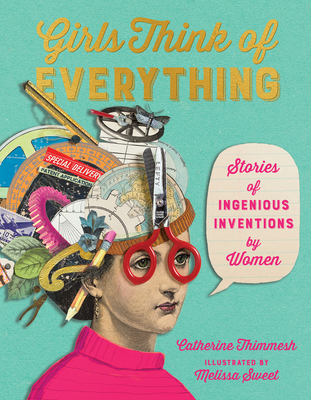
Girls Think of Everything by Catherine Thimmesh, illustrated by Melissa Sweet (Houghton Mifflin, 2002).

What do chocolate chip cookies, windshield wipers, and flat-bottomed paper bags have in common?  They were all invented by women!  Girls Think of Everything gives a glimpse at some of the many, many products invented by women. In some cases, women weren't allowed to patent their own inventions. In some cases, they had to fight to keep their ideas from being patented by men. In some cases, they weren't even allowed in the factories to oversee their own products being produced. But thank goodness women kept inventing things!  Short entries are accompanied by collage illustrations and a list of additional inventions by women is included in the back matter.  Bring along some of the items mentioned in the book and see if kids can guess what they have in common.

Skit Scat Raggedy Cat: Ella Fitzgerald by Roxanne Orgill, illustrated by Sean Qualls (Candlewick Press, 2010).

Ever since Ella Fitzgerald was a little girl, she had an unstoppable love for music.  When she was 14, her mother died, leaving Ella all alone and with no place to live.  But Ella didn't give up on her dream of performing.  She kept going to auditions, even though she looked like a "raggedy cat" since she didn't have money for fancy clothes.  It was hard at first, but people could see she had something special: her music made people want to get up and DANCE!  And soon, she wasn't a "raggedy cat" anymore, she was a "rowdy-dowdy high-hat baby" climbing the charts.  Ella went on to win 14 Grammy awards, including one for lifetime achievement.   Play some of Ella's music for the kids (I'm fond of the following clip if you have access to YouTube:)

Lives of Extraordinary Women: Rulers, Rebels (And What the Neighbors Thought) by Kathleen Krull (Harcourt Children's Books, 2000).

Which woman was not only one of her country's most successful rulers but also threw parties that lasted for 18 days?  Which woman forbid her subjects to call her queen, taking the title of king instead and leading her country in a war for its independence?  Which woman, when hit in the face with a rock during the middle of a speech, used her sari to cover the blood and kept speaking?  (Elizabeth I of England, Nzingha of West Africa [Angola], Indira Gandhi of India, respectively.)  In Lives of Extraordinary Women, Kathleen Krull gives us brief biographies, complete with juicy details, of 20 outrageous women from all over the world.

A Strong Right Arm: The Story of Mamie "Peanut" Johnson by Michelle Y. Green (Dial, 2002).

Ever since she could remember, Mamie Johnson loved playing baseball.  And I'm not talking softball here, I'm talking hardball.  She was a fabulous pitcher, striking out the boys in her neighborhood.  The problem?  Mamie was born in 1935, a time when women were not allowed to play professional sports.  When the All-American Girls' Baseball League was developed after many male baseball players went overseas to serve in the army, Mamie was hopeful that she could follow her dreams at last... but the League would not accept her because she was black.

Mamie still didn't give up.  She went on to play with the Negro Leagues - yep, a men's baseball league - and Mamie held her own. Her strong right arm took her far!

Almost Astronauts: 13 Women Who Dared to Dream by Tanya Lee Stone (Candlewick, 2009).

In 1960, the Space Race was all the rage and astronauts were American heroes.

They were also men.

Enter Jerrie Cobb and the rest of the "Mercury 13". In the early '60s, 13 women took and passed the same physical and psychological tests that men took to qualify for NASA's astronaut training program. But the "Mercury 13" women were not allowed to become astronauts, despite the fact that they were expert pilots. In fact, no woman went into space until Sally Ride did in 1983 and even then she didn't pilot the ship.

Almost Astronauts tells the story of the extraordinary women who fought for their right to make history, to go into space as qualified, talented astronauts.

Friday, March 11, 2011

Beautiful Minds: Teaching about Women in the Sciences through Picture Books

March 11 - Today's post provided by Teach with Picture Books

Nothing speaks more loudly than a good role model. As a teacher and a father to two daughters, I absolutely believe that. I therefore love picture books which chronicle the lives of women who, from their very childhoods, proved themselves to be innovative, independent, and incredibly resolute.

Additionally, I believe that picture book biographies serve a universal role in helping students realize that childhood dreams and interests may determine the paths they follow as adults.

Take, for example, Julia Morgan, who as a child loved to build. In her mind, buildings were huge puzzles, and she spent hours seeking to discover how all the pieces fit. Greatly influenced by her engineer father and her cousin Pierre LeBrun, an architect who designed many of Manhattan's stone churches and its first skyscrapers, Julia dreamed of becoming an architect.
The book Julia Morgan Built a Castle, written by Celeste Davidson Mannis and illustrated by Miles Hyman, describes Julia's dogged determination to first enter the prestigious Ecole des Beaux-Arts in Paris, and to then gain acceptance as a competent professional (unlikely for a woman in the early 1900's). Her success in both endeavors is inspiring to read, yet the story doesn't end there.

Morgan was a tireless architect who completed hundreds of projects while simultaneously working on William Randolph Hearst's incredible San Simeon estate (the "castle" of the book's title), which required twenty eight years to complete. In her design, Morgan ingeniously suspended the estate's massive 345,000 gallon Neptune Pool from steel reinforced concrete beams so that it would sway, rather than buckle, during California's frequent earthquakes. A simple narrative and Miles Hyman's glowing, sculpturesque illustrations combine to make this book a satisfying journey through the life of one remarkable woman. 

Marvelous Mattie: How Margaret E. Knight Became an Inventor, written and illustrated by Emily Arnold McCully, describes how a curious girl became one of America's most prolific inventors. McCully helps readers see that Mattie's childhood fascination with how common things work (a sled, a kite, a foot warmer) fueled her adolescent desire to improve the way machinery operated. While working in a textile mill at age twelve, for example, Mattie witnesses a serious injury when a rogue shuttle ejects from a loom and strikes a friend in the head. Young Mattie mulls the problem over; her solution, a metal guard, is adopted by all of the factories in Manchester. Injuries from flying shuttles cease immediately.

Mattie's later invention of a machine designed to create flat-bottomed paper bags (yes, those same bags we still use today) revolutionized the industry. Earlier flat bags needed to be held with one hand when packing, and ripped easily when overfilled. When she tries to file her patent for the machine, however, Mattie finds herself in a patent war with a man who most certainly stole her idea just days earlier. Fortunately, Mattie's detailed diagrams and meticulous notes prove her "priority of invention," and from that point forward she pursues a life as a professional inventor. Her obituary refers to her as "the Lady Edison."

Stone Girl, Bone Girl: The Story of Mary Anning, written by Laurence Anholt and illustrated by Sheila Moxley, provides readers with a more personal look at a scientist's childhood. This makes perfect sense in the case of Mary Anning, since she was only twelve when she discovered the fossil of a great sea monster on the coast of England. This ichthyosaur would be just the first of hundreds of rare fossilized animals Anning would uncover over her lifetime.

But the road to her success is not an easy one. At the age of fifteen months, Mary survived a bolt of lightning which killed her nurse and two other girls. Her father, who encouraged her interest in fossils, died when Mary was just a girl. The children who should be her friends teased her, calling out, "Stone Girl, Bone Girl, Out-on-your-own Girl!" Despite these obstacles, Mary Anning pursued her passion for the past, paving the way for other scientists in the field of evolution.

If you dig (pardon the pun) that story, you might also be interested in two other versions of Mary Anning's story. Catherine Brighton's The Fossil Girl: Mary Anning's Dinosaur Discovery tells the story of Mary's discovery through graphic novel format, complete with frames and speech bubbles. Mary Anning and the Sea Dragon, written by Jeannine Atkins with pictures by Michael Dooling, presents a much more mysterious, shrouded England, offering the reader just the slightest glimpse of the actual ichthyosaur. The emphasis is more on Mary's determination to see the job through. Teachers might consider sharing all three versions with students to generate discussion about choices made by writers and illustrators alike.

If you're seeking a book aimed at more independent readers, look no further than Jane Goodall: Researcher Who Champions Chimps, written and illustrated by Mike Venezia. (This book is from Getting to Know the World's Greatest Inventors and Scientists, just one of the excellent biography series created by Venezia).

From her earliest childhood, Jane dreamed of traveling to Africa to study the animals of that continent. Jane's father was a race car driver, often absent from the home scene, so Jane and her mother would spend hours in the garden observing plants, insects, and small mammals. Later, when evacuated from London during the bombings of World War II, Jane spent time exploring the rocky cliffs and pine forests of Bournemouth. She and her friends even formed a nature club, where a favorite pursuit was racing snails. During this time she continued to feed her imagination with tales of Tarzan and Dr. Doolittle.

Eventually Jane traveled to Africa where she met the legendary Dr. Louis Leakey and his wife, Mary. Leakey assigned her the task of observing chimps in a remote area, previously unexplored by human beings. Goodall's discoveries about those creatures amazed even Leakey himself. Jane was one of the first scientists to observe, for example, that chimps created and used tools. Scientists had believed that only humans did this!

Jane Goodall: Researcher Who Champions Chimps differs from the other books listed here in one special way: it introduces students to many standard conventions of nonfiction text: bold words, captions, a glossary, and an index. For that reason, this book would serve as a terrific transitional text to more formal textbooks which students will be seeing as they progress through school.

An equally intrepid yet much less celebrated explorer of Africa is brought to life in Uncommon Traveler: Mary Kingsley in Africa, one of many fascinating biographies written and illustrated by Don Brown. Unlike Jane Goodall, Mary Kingsley experienced a childhood which was by all measures bleak and uninspiring: her mother was constantly bed-ridden, her father was habitually traveling, and her brother was simply absent (sent off to school, although he was younger than Mary). Mary's only companionship were the many books in her father's library, and she devoured them (though how she even learned to read was a mystery).

With the passing of her mother, Mary was finally free of all obligations. Her dream? To explore West Africa. At the time such an enterprise was unthinkable, for West Africa was a land hostile even to its own people. How could a woman, a single woman for that matter, survive? But survive she did. Mary battled crocs, swam with hippos (not intentionally!), tumbled from a ledge through a thatched roof, stumbled into a spike-filled animal trap, was thrown from a canoe, and survived all manner of insects and other discomforts. She not only lived to tell her tale, but to write it as well, in two books which became best sellers. Her collected specimens not only filled her own home, but the showcases of the British Museum of Natural History as well. Mary was thirty when her mother died, and passed away herself at age thirty-eight, yet she lived more in those eight years than most people do in a lifetime!

Discussing the Books

The following questions might prove useful in discussing any of these books with children:
  • What are your interests? How might those interests affect what you choose to do for a living?
  • What is success? How does a person become successful?
  • What kinds of things might create obstacles, or problems, for someone who is trying to pursue their dreams?
  • Did women always have the same opportunities as men? What were some jobs that women were expected to do? What were some jobs reserved for men alone?
  • This book begins by telling us about _____'s childhood. Why do you think the author started there? 
  • Was following her dream difficult? What made it so hard? Who or what may have encouraged her, and convinced her to continue?
  • What is determination? How was it exemplified through _______'s actions?
  • If this woman were alive today, what advice might she give us?
  • Let's look again at the illustrations. How do they help us understand the story better? What information do the illustrations supply that the text doesn't? How did the book's illustrator know what these events looked like?
  • What other information does the author provide?
  • What questions do we still have about ___________?
  • If ___________ were alive today, what would surprise her most about how the world has changed since her time?
  • If we had to give __________ a nickname, what would we choose?
As a follow up activity, students could create a new book jacket for any of these books. You might even consider covering the book's actual cover while reading it aloud, and only uncovering it later once all students have completed their designs. At ReadWriteThink you'll find a nice interactive which explains the elements of a traditional picture book cover, and you can additionally have students create the entire book cover online (or just a cover or back) using the cool interactive Book Cover Creator. (Personally, I might have some parent helpers cut down some brown paper shopping bags, and use the reverse blank sides for the project; this would be a neat homage to Margaret E. Knight).

Online Explorations of Women in Science

Women's Adventures in Science features a cool look at real, live scientists practicing in their fields. Students can choose from Ten Scientists, and each is linked to a kid-friendly site featuring a biography, videos, games, and related links. These biographies are rich, and definitely made for the third grade and above crowd. As a class project, students could be paired and assigned a scientist to research using this site.

You'll also find an Interactive Timeline (1900 to present), which, while not well populated, definitely points out that the number of women in the fields of science has increased dramatically during the last century. The Ask It section allows students to pose their questions about science to real scientists. They can also browse answers to dozens of questions already asked. And, of course, a Games section!

Another terrific site to explore is PBS's very hip SciGirls, which is filled with projects, profiles, and videos featuring women in science. This site is awesome in that it helps students (okay, mostly the girls) realize that they, too, can be scientists, right now! (Note that site features a section which allows girls to interact socially, so standard precautions should be taken to address Internet safety issues). The Teacher's Overview provides a number of different approaches as well as additional resources for using the site.

I personally think a SciGirls Club sounds like a pretty awesome idea for a school or homeschool group, and this site would be a great place to start! Don't forget, though, to inspire your girls with some real-life role models, and those provided in the books I've shared are highly recommended.
Need one more? Cool interactive games to learn about inventions and inventors (including lots of women inventors!) can be found at Inventive Kids. No registration or annoying pop-ups, just easy-to-play games that teach as kids play
Looking for more on- and off-line explorations in science? Check out Exploring Invention with Picture Books at Teach with Picture Books. In addition to the dozen plus sites listed there, be sure to check out some terrific science bios written by author Kathleen Krull, a recent contributor to the Kidlit Celebrates Women's History Blog.

Editor's Note: Keith Schoch is a sixth grade Reading/Language Arts teacher in Bedminster, NJ. In addition to presenting workshops and writing teaching guides, Keith shares practical teaching tips through three blogs: Teach with Picture Books, How to Teach a Novel, and Teaching that Sticks.