Showing posts with label NASA. Show all posts

Sunday, March 27, 2011

Nonfiction about Amazing Women

March 27 - Today's post provided by Waking Brain Cells
Nonfiction about Amazing Women
Children’s nonfiction is a great place to take a look at women who should be part of our history books but so often are overlooked and forgotten.  Here are four books that each child, girl or boy, should know about to have a more complete understanding of the role of women in history and today:
Almost Astronauts by Tanya Lee Stone
Published in 2009, Stone’s book about the Mercury 13 women won the 2010 Sibert Medal and was also nominated for a YALSA Award for Excellence in Nonfiction for Young Adults.  It is the story of women who tried to be astronauts before females were allowed in the NASA program.  It is the story of women denied their right to be astronauts despite exceeding the mastery of the men in the program.  It is the story of women of strength and character who have been forgotten by history.
Amelia to Zora: Twenty-Six Women Who Changed the World by Cynthia Chin-Lee, illustrated by Megan Halsey and Sean Addy
This 2005 title celebrates 26 women who changed the world.  Appropriate for younger children than the other books on this list, this picture book gives short pieces of information on these amazing women.  Included in the title are Amelia Earhart, Frida Kahlo, Nawal El Sadaarvi, and Zora Neale Hurston.  The women represent a wide range of ethnicities and each has a quote included as well.  The illustrations add a beauty to the book, celebrating the women in a moving way.
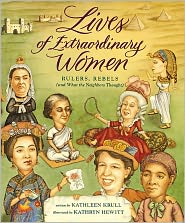
Published in 2000, Krull’s book about 20 extraordinary women in history is part of her very entertaining series on historical figures.  This book celebrates women like Cleopatra, Harriet Tubman and Eleanor Roosevelt.  Nicely, it includes women around the world.  If you like humor mixed with your nonfiction, Krull is the author for you!
Published in 2004, this book is a visually powerful history of the fight for women’s right to vote in the United States.  The book follows the evolution of the suffrage movement, telling the story of the courageous women who fought for the right to vote against all odds.  It is a story of courage despite imprisonment, of the strength to protest despite derision, and of the passion for voting that so many of us have forgotten today.  These are women who should be listed with other heroes in our country and whom are often forgotten.
Editor's Note:

Authors Tanya Lee Stone, Kathleen Krull and Ann Bausum have each graciously contributed posts here this month. 

Waking Brain Cells is the new online home of longtime blogger, Tasha Saecker. If you have been wondering about her new location, wonder no more - you can find her at Waking Brain Cells.

Tuesday, March 15, 2011

Booktalks for Women’s History Month

MARCH 15 Today's post is provided by Abby the Librarian

I am always on the lookout for great titles to booktalk for Women's History Month, so I wanted to share a few of my favorites here with you today!

Amelia Lost: The Life and Disappearance of Amelia Earhart by Candace Fleming (Schwartz & Wade, 2011)

You know the story of Amelia Earhart, right?  She was a famous female pilot, flying across the country and even across the Atlantic Ocean back when airplanes were not nearly as common as they are today.  But Amelia Lost tells Amelia's story like no other book has.  The book switches between biographical information about Amelia and the story of the days of her disappearance.  In a gripping narrative, Candace Fleming relates what happened on the day that Amelia Earhart disappeared.  There were several reports of civilians (even children) picking up what might have been snatches of Amelia's radio broadcasts as her plane crash-landed on a remote island in the Pacific!  Can you imagine turning on your radio and hearing Amelia Earhart's voice calling for help?

This book brings Amelia's story to life as no other book has done.  Even if you think you know the story of Amelia Earhart, it's worth picking up Amelia Lost to give it another look!

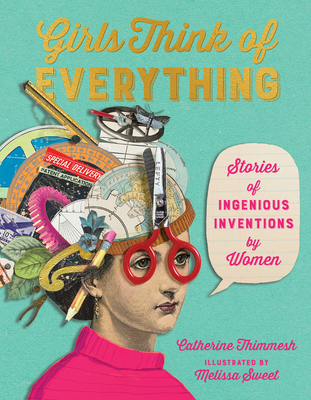
Girls Think of Everything by Catherine Thimmesh, illustrated by Melissa Sweet (Houghton Mifflin, 2002).

What do chocolate chip cookies, windshield wipers, and flat-bottomed paper bags have in common?  They were all invented by women!  Girls Think of Everything gives a glimpse at some of the many, many products invented by women. In some cases, women weren't allowed to patent their own inventions. In some cases, they had to fight to keep their ideas from being patented by men. In some cases, they weren't even allowed in the factories to oversee their own products being produced. But thank goodness women kept inventing things!  Short entries are accompanied by collage illustrations and a list of additional inventions by women is included in the back matter.  Bring along some of the items mentioned in the book and see if kids can guess what they have in common.

Skit Scat Raggedy Cat: Ella Fitzgerald by Roxanne Orgill, illustrated by Sean Qualls (Candlewick Press, 2010).

Ever since Ella Fitzgerald was a little girl, she had an unstoppable love for music.  When she was 14, her mother died, leaving Ella all alone and with no place to live.  But Ella didn't give up on her dream of performing.  She kept going to auditions, even though she looked like a "raggedy cat" since she didn't have money for fancy clothes.  It was hard at first, but people could see she had something special: her music made people want to get up and DANCE!  And soon, she wasn't a "raggedy cat" anymore, she was a "rowdy-dowdy high-hat baby" climbing the charts.  Ella went on to win 14 Grammy awards, including one for lifetime achievement.   Play some of Ella's music for the kids (I'm fond of the following clip if you have access to YouTube:)

Lives of Extraordinary Women: Rulers, Rebels (And What the Neighbors Thought) by Kathleen Krull (Harcourt Children's Books, 2000).

Which woman was not only one of her country's most successful rulers but also threw parties that lasted for 18 days?  Which woman forbid her subjects to call her queen, taking the title of king instead and leading her country in a war for its independence?  Which woman, when hit in the face with a rock during the middle of a speech, used her sari to cover the blood and kept speaking?  (Elizabeth I of England, Nzingha of West Africa [Angola], Indira Gandhi of India, respectively.)  In Lives of Extraordinary Women, Kathleen Krull gives us brief biographies, complete with juicy details, of 20 outrageous women from all over the world.

A Strong Right Arm: The Story of Mamie "Peanut" Johnson by Michelle Y. Green (Dial, 2002).

Ever since she could remember, Mamie Johnson loved playing baseball.  And I'm not talking softball here, I'm talking hardball.  She was a fabulous pitcher, striking out the boys in her neighborhood.  The problem?  Mamie was born in 1935, a time when women were not allowed to play professional sports.  When the All-American Girls' Baseball League was developed after many male baseball players went overseas to serve in the army, Mamie was hopeful that she could follow her dreams at last... but the League would not accept her because she was black.

Mamie still didn't give up.  She went on to play with the Negro Leagues - yep, a men's baseball league - and Mamie held her own. Her strong right arm took her far!

Almost Astronauts: 13 Women Who Dared to Dream by Tanya Lee Stone (Candlewick, 2009).

In 1960, the Space Race was all the rage and astronauts were American heroes.

They were also men.

Enter Jerrie Cobb and the rest of the "Mercury 13". In the early '60s, 13 women took and passed the same physical and psychological tests that men took to qualify for NASA's astronaut training program. But the "Mercury 13" women were not allowed to become astronauts, despite the fact that they were expert pilots. In fact, no woman went into space until Sally Ride did in 1983 and even then she didn't pilot the ship.

Almost Astronauts tells the story of the extraordinary women who fought for their right to make history, to go into space as qualified, talented astronauts.

Monday, March 7, 2011

So Many Women, So Little Time

March 7 - Today's post provided by Tanya Lee Stone

So Many Women, So Little Time

As I thought about which woman to cover in my blog post for Women’s History Month, too many flooded my consciousness. The bookshelves of my house are laden with their names: Gloria Steinem, Betty Friedan, Naomi Wolf, Amelia Earhart, Jane Addams, Elizabeth Cady Stanton, Rosalind Franklin, Judy Blume, Golda Meir, Lillian Hellman, Marge Piercy, Sojourner Truth, Ida B. Wells, and well, the list truly does go on for days. So how to pick just one? I decided not to, for it is their collective effect that has made me who I am today. Instead I would like to share my thanks for the essence of these women and many more, for the impact they created by living the truths of their lives, for the tides they turned, the boundaries they pushed, the fences they toppled.

Golda Meir
Let me begin with the woman who influenced my earliest girlhood—Golda Meir. She was the Prime Minister of Israel from 1969 to 1974. All my 9-year-old self knew about Golda Meir was how impressive it was that a woman was both leading a nation and trying to shape a vision of peace in the Middle East. That was enough to make me empty my stainless steel piggy bank and ask my parents to send her all my money.

Fast forward to college. I went to Oberlin, the first co-educational college in the United States. There I read Ayn Rand, Lillian Hellman, Marge Piercy, Rachel Carson, Annie Dillard, Virginia Woolf, Alice Walker, Lorraine Hansberry, and Toni Morrison. Outside the classroom, I learned almost by osmosis from students who threw their passions into causes and dedicated themselves to informing their fellow women (and men). Every day brought a new revelation—rallies and petitions and flyers handed to me en route to the mailroom on issues of health care rights, lesbian rights, rights for women in third world nations, oppressed women, women who needed a voice—and women who used their voices in the name of others.

I emerged from this experience with deep-held ideas about women and women’s history, and yet I still balked at the word feminist. A few years later, a dear male friend from Oberlin was visiting who, upon discovering I did not label myself a feminist, became rather annoyed with me. How is that possible with all you believe in, and why do so many women disconnect themselves from that term, he wanted to know—quite rightly. It was a valid question. It is a loaded word. And in fact, it was his supreme irritation that sparked my acute realization that I WAS, and likely had always been, a feminist. I didn’t know then that I would spend a good deal of my writing career telling stories that celebrate women’s history, but looking back, my roots are clearly visible.

Now those roots nurture the directions my own branches stretch. Sometimes it’s deep into our past with women like Elizabeth Cady Stanton and Jane Addams in the picture books I write. And sometimes it’s the not-so-distant-past with women like the “Mercury 13” who helped break down the gender boundaries in our space program and pave the way for women astronauts. Spending time with many of these women, whose story I told in Almost Astronauts: 13 Women Who Dared to Dream, illustrated the fact that women shape our world in a broad variety of ways. There is no one “type” of feminist and all who strive for change are to be celebrated.

That idea was further cemented as I sat in a room last year filled with hundreds of women, all in attendance to hear Gloria Steinem speak. At the end of her moving lecture—delivered with the ease of a confident soul—she invited anyone to come to the microphone and state her own ideas for change. As the line began to grow and weave around the back of the room, and the ideas began to flow, the realization that women make history in every community, every day, moved me to tears.
Gloria Steinem

The icing on the cake? I met Ms. Steinem afterwards and handed her a copy of Almost Astronauts. She looked at it and said, “Oh! I am so excited that you wrote this story!” I then showed her my source note citing the 1973 article about these women in her Ms. magazine. She smiled and handed me a signed copy of her book, Outrageous Acts and Everyday Rebellions. It wasn’t the torch being handed from one woman to another—it was the acknowledgement that we are all in this feminism and women’s history work together.

I know I am not alone in the fact that many, many women helped shape my own ideals—just as many, many women helped shape theirs. It is this far-reaching, intimate, and intricate sisterhood of the world that I am both fascinated by and grateful for—and so I say to all of you, Happy Women’s History Month!


Editor's Note:
Tanya Lee Stone studied English at Oberlin College and was an editor of children's nonfiction for many years. She also has a Masters Degree.
After many years as an editor, Tanya moved to Vermont and returned to writing. This award-winning author has written titles that include the young adult novel, A Bad Boy Can Be Good for a Girl (Wendy Lamb/Random House), Up Close: Ella Fitzgerald (Viking),  picture books Elizabeth Leads the Way (Holt, April 08), Sandy's Circus (Viking, Sept 08), Almost Astronauts: 13 Women Who Dared to Dream (Candlewick 09), and The Good, the Bad, and the Barbie (Viking 2010). Forthcoming titles include Who Says Women Can't Be Doctors?! (Holt) and Courage Has No Color (Candlewick).

Tanya Lee Stone blogs at http://tanyaleestone.livejournal.com/