Showing posts with label compendiums. Show all posts

Sunday, March 29, 2015

Woman Who Faced Amazing Challenges & Succeeded

March 29 - Today's post contributed by Alyson Beecher

Woman Who Faced Amazing Challenges & Succeeded
by Alyson Beecher

If you were asked to name a woman in history who made a significant contribution and who also had a disability of some type, who would you name? Most people would probably name Helen Keller. However, I was curious about other women who had made or were making a difference and who also had some form of a disability. So, off to Google I went.

My simple search produced some familiar names and some names that were new to me. Helen Keller was obviously on the list but so was Harriet Tubman, and Frida Kahlo. Each of these women have numerous biographies written about them in both picture book and long-form. The famous photographer, Dorothea Lange is well known for her photography but lesser known for the limp she grew up with as a result of polio when she was a child. Wilma Mankiller, Principal Chief of the Cherokee Nation, has a chapter in a picture book celebrating famous woman and her work with the Cherokee Nation, but did you know she also served in this position while having a rare form of muscular dystrophy? Really, just a chapter in a picture book?

However, I learned about some other woman who had made notable contributions to their communities and countries and yet, little were written about them.  Jhamak Ghimire who has severe cerebral palsy and considered the “Helen Keller of Nepal” has nothing written about her in the United States, except for her own work of poetry. Judy Neumann, and Harilyn Rousso have had significant careers and lives advocating for individuals with disabilities and yet despite their life's work would not be easily recognized by most teachers and children.

After serving on the Schneider Family Book Award Jury (a children’s and young adult book award committee of the American Library Association) for the past few years, I have read a lot of books featuring individuals with special needs. However, in the category for young children, with the exception of books about Helen Keller, there were no books portraying the lives of any of these other amazing woman and the work that they have done while also living with additional challenges. Do we have a book gap? I would certainly say yes.

Though this is not a comprehensive list by any means, I would like to highlight the lives of just a few of the incredible woman who embody the spirit and essence that surrounds Women’s History Month and who are also powerful role models for our young readers who may be empowered to dream beyond their special needs because of these amazing women.

Moses: When Harriet Tubman Led Her People to Freedom by Carole Boston Weatherford; Illustrated by Kadir Nelson
Despite what I had read on Harriet Tubman in the past, it had primarily focused on her leadership and active role in assisting slaves to escape to freedom. Somehow, I had missed the fact that Tubman suffered from epilepsy along with severe headaches and narcolepsy as a result of a head injury she suffered when she was young at the hands of another slave’s overseer.

Frida by Jonah Winter; Illustrated by Ana Juan
Viva Frida by Yuyi Morales 

One of the things that have always struck me is how Frida Kahlo was able to utilize her pain and life experiences to produce so many amazing pieces of art. As a child, she contracted polio and was left with a limp, then at 18 she was in a serious bus accident, which left her in chronic pain. Kahlo lived a colorful live with her marriage to artist Diego Rivera and her political activism.

Dorothea Lange by Mike Venezia
As a child, Dorothea Lange contracted polio which left her with a limp due to a weakened right leg and foot. However, she did not let this or later health issues impede her work as a photographer and publisher. It was her goal to use her photography to bring attention to injustices, which she hoped would result in a change of action in people. Her depression era photography of rural hardship became her best known work.

Amelia to Zora: Twenty-six Women Who Changed the World by Cynthia Chin-Lee; Illustrated by Megan Halsey, Sean Addy 
Photo of Wilma Mankiller taken at the 2001 Cherokee National Holiday. Photo by Phil Konstantin
Wilma Mankiller was a lifetime activist and advocate for the rights of Native Americans and women. In 1985, she became the Principal Chief of the Cherokee Nation During her term as Principal Chief, she worked to improve health care, education and government for native americans. After a nearly fatal car crash, Mankiller was diagnosed with a form of muscular dystrophy.

Harilyn Rousso
Harilyn Rousso is not only a disability rights activist but also an activist for the rights of women with disabilities. Highly educated, Rousso has utilized her personal experiences, education, and passions to establish a number of organizations to address issues of gender and disability.

Judith Heumann, Photo from U.S. State Department
As a toddler, Judy Heumann developed polio which left her needing to use a wheelchair for the rest of her life. Heumann has spent her life advocating for the rights of those with disabilities. After college, she fought against New York State in court to be granted the right teach elementary school as an individual in a wheelchair. She later served as the Assistant Secretary of Special Education during the Clinton Administration. Currently, she works as an International Disability Rights Special Advisor advocating human rights legislation for children and adults with special needs.

"Jhamakawarded" by Madan Puraskar org . Licensed under CC BY-SA 3.0 via Wikimedia Commons http://commons.wikimedia.org/wiki/File:Jhamakawarded.jpg#/media/File:Jhamakawarded.jpg

Though Jhamak Ghimire may not be able to speak or use her hands due to cerebral palsy, she has still managed to write poetry and be recognized in her native land of Nepal as an award winning poet.

Helen’s Big World: The Life of Helen Keller by Doreen Rappaport; Illustrated by Matt Tavares
Of course, I couldn’t leave out Helen Keller. Likely of the most recognized influential women who also happened to have a disability, Keller showed that despite being both blind and deaf that you can learn and you can make a difference.

What strikes me about each of these women is how hard they must have worked. Each one of these women shows us what is possible despite our personal limitations. When I think of the headaches that Harriet Tubman experienced or the chronic pain of Frida Kahlo, I am in awe. Pain is hard and yet, neither of these women allowed it to stop them from accomplishing what they were meant to do.

Mankiller, Heumann, and Rousso dedicated their lives to advocating for others. When I look at the accomplishments of these women, I almost feel like an underachiever.  They have not allowed what might be seen by others as limitations to limit them.

Lange, Kahlo, and Ghimire have used their experiences to enhance their artistic expression. Ghimire is particularly inspiring in that her own country as well as her body would have left her without a voice and yet through her writing she has found that voice.

Next time, I find myself thinking I am unable to do something, I need to remind myself how much each of these women have contributed to their communities and even the world by what they were able to accomplish while facing incredible challenges.


Alyson Beecher is an educator, book geek and literacy advocate with over 20 years of experience in education.  Currently, she is the K-8 Literacy Specialist for the Pasadena Unified School District in Pasadena, CA.  Alyson has served as the Chair of the ALA 2015 Schneider Family Book Award Jury and was an Elementary/Middle Grade Nonfiction second round judge for the CYBILS. She can be found on twitter @alybee930 or through her blog www.kidlitfrenzy.com


Friday, March 20, 2015

The Women Whose Names We Don't Know, by Kate Schatz

March 20 - Today's post contributed by Kate Schatz


The Women Whose Names We Don’t Know
By Kate Schatz


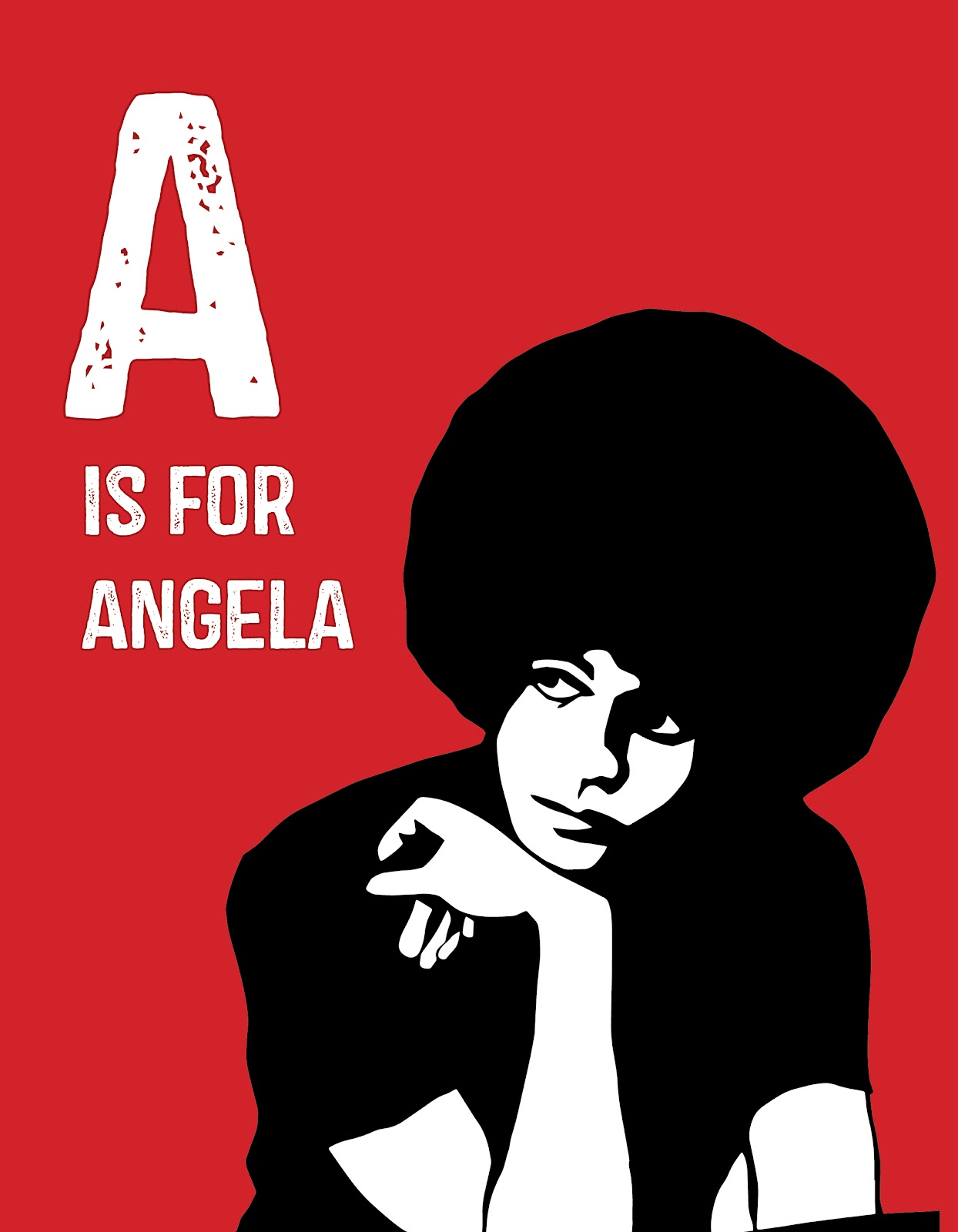
My children’s book Rad American Women A-Z is an A-Z book of, well, rad women from American history. For each letter of the alphabet I profile a diverse, fascinating American woman who faced adversity and made a difference. Short bios are accompanied by bright, bold papercuts from artist Miriam Klein Stahl. Some of the women are well-known, some are more obscure, and they represent several centuries, various cultural backgrounds, and a broad swath of careers and accomplishments. A is for Angela Davis, B is for Billie Jean King, C is for Carol Burnett, and on and on...That is, until you get to X.
RADWomenFINAL6.jpg


X is a tough letter in the English language. It’s the third least commonly used letter (behind Q and Z), and most dictionaries include only about 120 words that begin with X. Anyone who’s read a children’s ABC book knows that the entry for X is usually….a stretch. It’s good news for the xenops, the xolo, and uh, xanthan gum, and often people cheat a bit (eXit! Xtra! Xmas!) But for this book, I didn’t want to force it or fudge. So when a friend suggested that X stand for “the women whose names we don’t know”, it felt like a possible solution.


As I embarked on my lengthy research process, learning more and more about women’s history and the incredible stories of the women who’ve endured and accomplished so much, this ‘X’ idea increasingly resonated. I consider myself well-versed in women’s history—I’m a feminist writer! I was a Women’s Studies major! I read books about women’s history for fun!—but the more I read and researched, the more I realized how much I don’t know. How many names and stories haven’t made it into even the most progressive revisionist history books, and how many names and stories we just won’t ever know. I regularly stumbled upon a woman I’d never heard of, and found myself thinking “She’s amazing! How have I not heard of her?!” It also made me think about ‘greatness’ and how we select our hero/in/es. While it’s essential that we celebrate specific individuals—exactly what I do with this book—one can’t escape from the realization that none of these women worked alone. That even the most trailblazing groundbreakers had friends, lovers, mothers, mentors, and other contemporaries who aren’t always part of the stories. Some of that is just the nature of the scope of history—we literally can’t capture and tell every story—but it’s still a significant factor. How do we define and determine greatness and heroism? What kinds of feats and deeds do we celebrate, and what goes unheralded?
RADWomenFINAL52.jpg


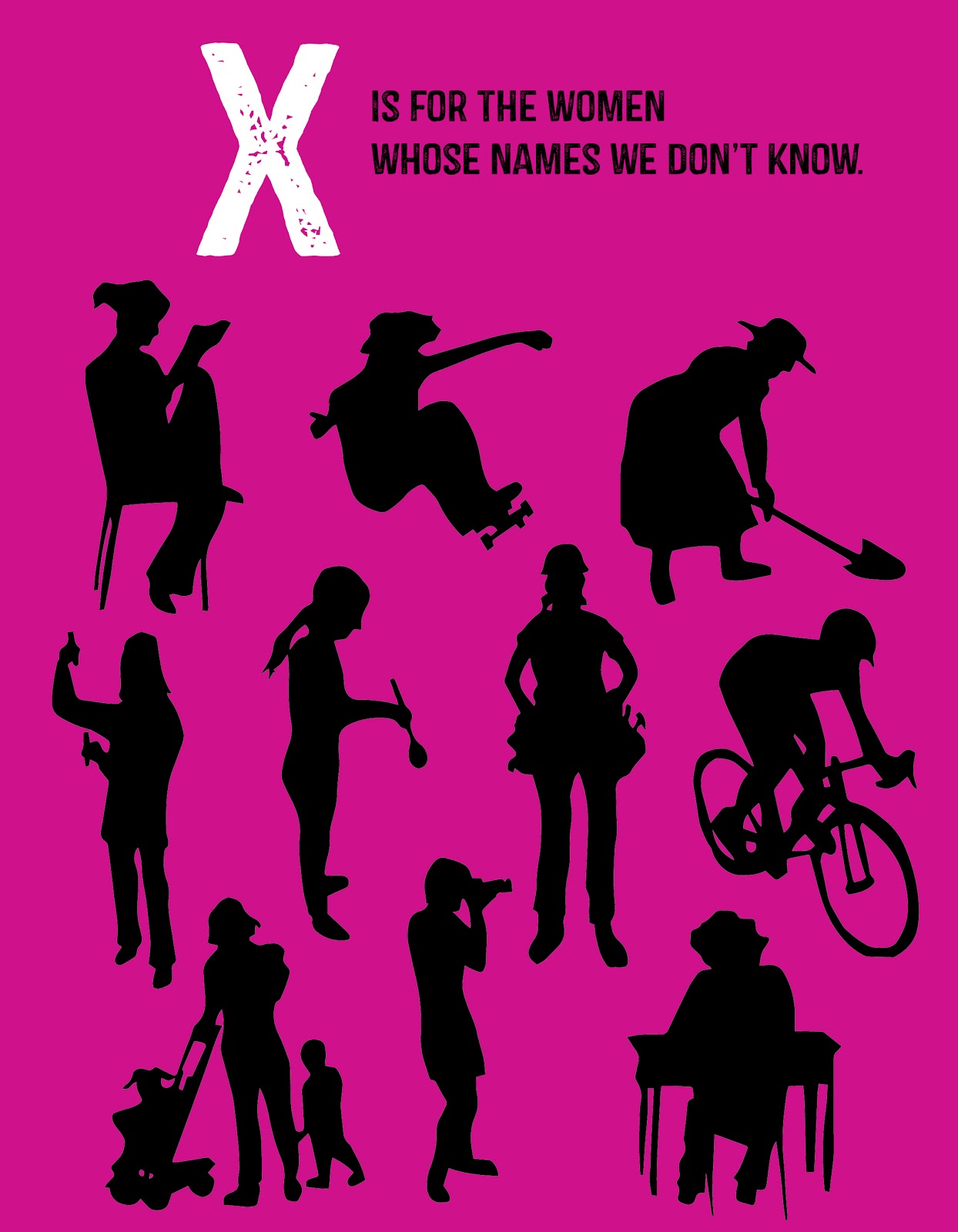
So X is for the women whose names we don’t know. The idea of a friend became the entry. Miriam came up with the idea to create silhouettes of women engaged in myriad tasks, and I sat down to write an entry for it. The first few drafts were sad. Like, really sad. And pretty angry. I wrote and I cried as I thought about all that women have been denied—education, property, personal decisions, their own children—and how these denials have especially impacted women of color and other marginalized individuals. Once I’d worked through the negative emotions, though, I began to see hope in the phrase as well. I thought about my own daughter, her friends, and the high school students that I work with almost every day. I thought about all the young women whose names we don’t know because they have yet to invent their big invention or embark on their great journey. The women who will shape our futures aren’t famous yet—because they’re 5, or 15, or 50. We don’t know their names now, but we will, and that is what X is for.


X is for the women
whose names we don’t know.
It’s for the women we haven’t learned about yet, and the women whose stories we will never read.


X is for the women whose voices weren’t heard.


For the women who aren’t in the history books, or the Halls of Fame, or on the postage stamps and coins.


For the women who didn’t get credit for their ideas and inventions.


Who couldn’t own property or sign their own names.


The women who weren’t taught to read or write but managed to communicate anyway. Who weren’t allowed to work but still supported their families, or who worked all day but weren’t paid as much as the men.
X is for the radical histories that didn’t get recorded.
X is for our mothers, our matriarchs, our ancestors.
The nurses and neighbors and aunties and teachers.
The women who made huge changes and the women who made dinner.
X is for the hands that built and shared and wrote and fought.
The bodies that birthed and worked and strained.
The feet that walked, ran, jumped, and balanced.
The minds that dreamed and desired, the hearts that loved.
X is also for all that’s happening now and all that is still to come.
X is for the women in homes and offices and fields and labs and classrooms,
who invent and transform and build and create.


It’s for you and for me, the girls and boys and men and women and everyone in between helping to make the world safe, compassionate, and healthy.
X is for all we don’t know about the past, but X is also for the future.
X marks the spot where we stand today.
What will you do to make the world rad?


Now this page is the favorite of my daughter Ivy, as well as Miriam’s 8-yr old daughter Hazel. Hazel reads it over and over, while Ivy, who’s still learning to read, studies each silhouette image, selecting which ones are “mama” and which ones are “her.” She usually selects them all for herself—the scientist, the gardener, the construction worker, even the skateboarder. She hasn’t been on a skateboard yet, and is still mastering the bike with no training wheels. And that’s why I love it when she chooses that one—because the future is enormous, and so is her potential.


Kate Schatz is the author of Rad American Women A-Z: Rebels, Trailblazers, and Visionaries who Shaped Our History . . . and Our Future! published by City Lights/Sister Spit. She's also the author of Rid of Me: A Story, which is definitely not a kid's book. She directs the Department of Literary Arts at a public arts high school in Oakland, and lives on an island.