Showing posts with label Alice Paul. Show all posts

Tuesday, March 19, 2013

Light Your Handmade Lamp for Women's Suffrage

March 19 - Today's post contributed by Kerrie Logan Hollihan

Light Your Handmade Lamp for Women’s Suffrage

When I was in AP American history class at North Allegheny High School a long time ago, the guy who sat in front of me mentioned a couple lines in our textbook that showed up on one of our tests.  “The Grimkee sisters?” he said, shaking his head as if to say “Who could possibly care?”


 I agreed.  Who could possibly care about a couple of women who did some minor thing about abolition?

Later I did -- much later. Fast forward 40+ years, when I wrote about them in my book Rightfully Ours: How Women Won the Vote, which appears this year on the ALA Amelia Bloomer List. The sisters, Angelina and Sarah Grimké, daughters of a Southern judge and slave owner, hated the idea that anyone, including their father, could own other human beings. 
First Sarah, and later Angelina, took the drastic step of leaving home and moving north to Philadelphia. There they became Quaker women, free to speak openly during worship. The Southern sisters then took things further and went on tour to speak about abolition in public meetings. At this point, even their fellow Quakers frowned when the Grimké sisters spoke in public.  Other women -- Susan B. Anthony and Lucy Stone especially, also found their voices as abolitionists and only later began to work for women’s right to vote.

Rightfully Ours covers the lives of many American women -- some well-known, such as Anthony; others not quite as much: Lucy Stone, Elizabeth Cady Stanton, Alice Paul; Carrie Chapman Catt and “footnotes” like the Grimké sisters. I was grateful when my editor suggested I write a history of the American suffrage movement -- CRP was looking for a book on the topic.

My previous book, Elizabeth I: the People’s Queen: Her Life & Times had taken me back to Tudor England, researching and writing the life of one, very strong woman who came to power almost by accident. This time, there was a host of women to study, and by the time I was ready to start writing, I’d read parts of at least 60 books just to feel familiar with these women and the world they inhabited.

Rightfully Ours is my fourth book with Chicago Review Press, and what makes these “For Kids” books a bit different is that we authors must develop at least 21 themed activities to enhance what we write.  Hence the “21 Activities” you’ll see on the cover of most of CRP’s broad-ranging series of books for middle grade readers. We develop these to appeal to a broad audience -- and I blog with my fellow “for Kids” authors Mary Kay Carson and Brandon Marie Miller at Hands-on-Books, where we talk about our books and offer downloadable activities.  (http://hands-on-books.blogspot.com)

In my books I like to include a few activities with a scientific touch. For Rightfully Ours there are several -- one on how to locate Polaris (the North Star), and another, Make a Five-Pointed Star with Just One Cut.

Today I’m sharing a favorite of mine.  In their early days, women like Anthony, Lucy Stone, Elizabeth Cady Stanton, and the Grimké sisters read by the light of whale oil lamps.  I fashioned an activity for Rightfully Ours so that my readers can make lamps of their own using not whale oil of course, but olive oil. It’s easy to make one using things you can find around the house and in craft stores -- and these little lamps really do work!


Kerrie Logan Hollihan writes award-winning nonfiction for young people. Her books have been honored by the ALA’s Amelia Bloomer List, Smithsonian magazine, the National Science Teachers Association, the Chicago Public Library, and the Junior Library Guild.

Hollihan channeled her “inner sixth grade girl who read Compton’s encyclopedia for fun” and started writing for kids in 2005. She’s the author of 38,000 word biography/activity books about Isaac Newton, Theodore Roosevelt, Queen Elizabeth I, and the women’s suffrage movement in the U.S., as well as an early reader series on Latin American celebrations. Either way, Hollihan says, every word counts.

“Kids don’t get enough credit for being able to understand history as it actually happened. As I research and write, I think about how to explain the ‘whys’ of situations as well as the ‘whats.’

“History is filled with great yet fully human men and women with faults and foibles. When I write about famous people and their times, there are tough issues to address -- segregated America and religious persecution in England are topics I’ve explained to my readers.”

Hollihan, mother of two grown children, lives with her pilot husband Bill in Blue Ash, Ohio. 

Friday, March 4, 2011

On March 4, Remember the "Grand Picket" for Voting Rights

March 4 - Today's post provided by Ann Bausum
On March 4, Remember the Grand Picket for Voting Rights
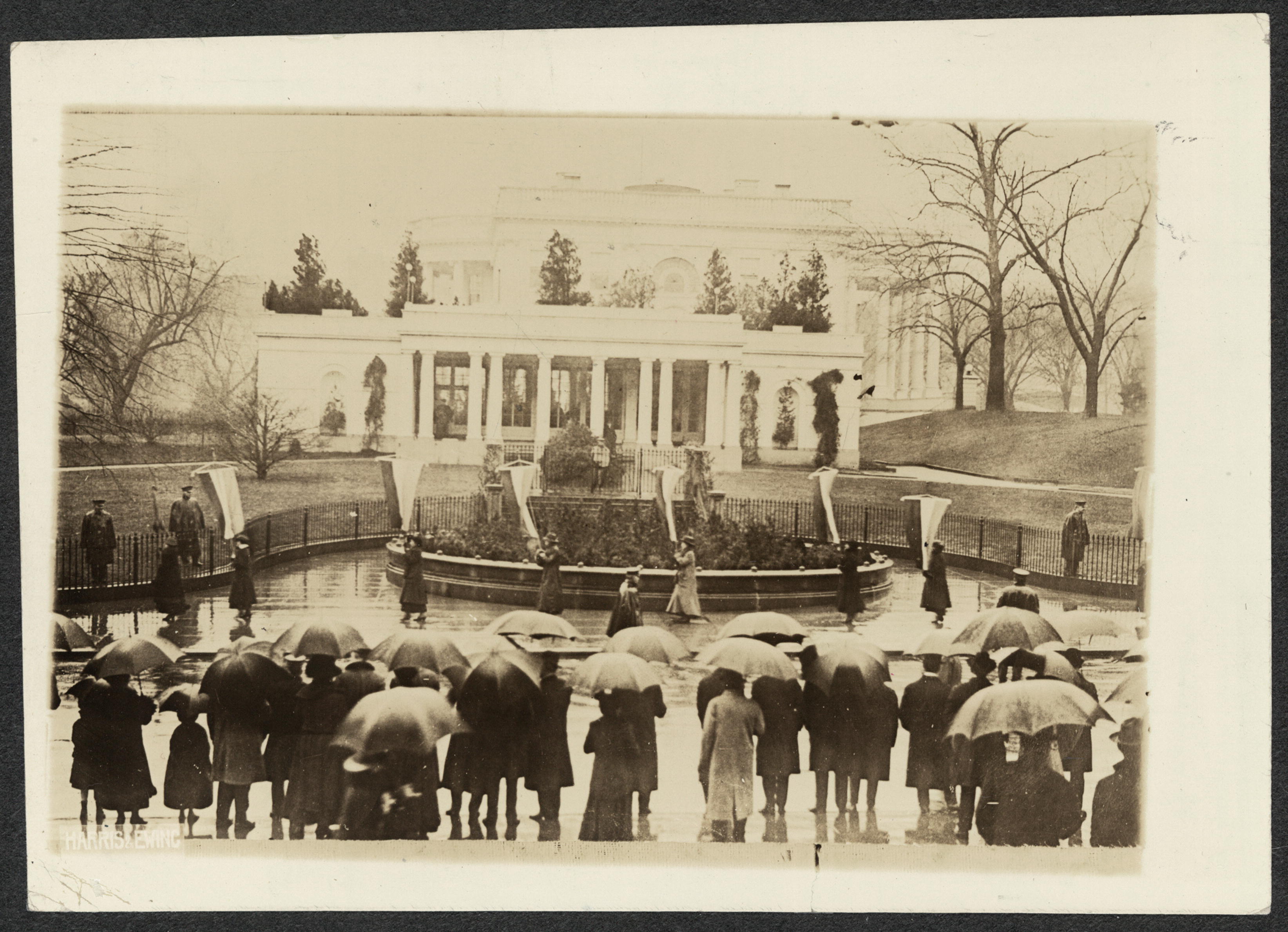
Suffrage pickets marching around the White House-- March 4, 1917
The finale to the 72-year-long fight for women’s voting rights occurred during the two-term Presidency of Woodrow Wilson. Women mounted a fierce campaign against his reelection in 1916 after he had neglected their calls for support of woman suffrage during his first administration. Wilson’s victory pushed the most radical of the suffragists—a group that became known as the National Woman’s Party—to mount a campaign of civil disobedience in protest.
The woman began their efforts on January 10, 1917, by mounting daily pickets in front of the White House. Volunteers stood for hours in all weather holding protest signs with messages such as “Mr. President, what will you do for woman suffrage?” and “How long must women wait for liberty?”
Picketing the White House at Wilson's second
inauguration, March 4, 1917
To mark the occasion of the President’s second inauguration (which in those days took place in early March), the National Woman’s Party organized what it called the “grand picket.” A thousand women gathered from all over the country to march on the White House carrying a resolution that urged President Wilson to act on the cause of woman suffrage during his second term of office.
In spite of horrible weather, the event proceeded as planned on inauguration day, March 4, 1917. Women lined up in single file, fighting a stiff wind to hold aloft their protest banners as an icy rain drenched their clothes. Two bands accompanied the procession and played hymns, marches, and protest songs. Thousands of spectators lined their route around the perimeter of the presidential mansion, as did a double row of police officers. Federal workers unsympathetic to the cause watched in amusement as the women passed their office windows.
The procession stopped at all of the residency’s three main entry gates only to find each in turn had been locked with orders to deny all access by the protesters. Guards, obeying instructions, refused to accept the petition and carry it inside. One more sympathetic guard offered to receive the document at a service entrance, but the women elected not to leave their official plea at “the gate where Mrs. Wilson’s clothes and other packages are left.”
The marchers, who ranged in age from 20 to 84, persisted in their parade around the White House, hoping to attract the President’s attention. They lapped the fenced grounds four times over the course of two hours in spite of battering rain and wind. Late in the afternoon participants watched in dismay as President and Mrs. Wilson departed the White House in a chauffeured car, proving that Wilson had deliberately ignored their attempts to contact him.
“This one single incident probably did more than any other to make women sacrifice themselves” later on, wrote suffragist Doris Stevens in her memoir of the voting rights fight, Jailed for Freedom. “Even something as thin as diplomacy on the part of President Wilson might have saved him many restless hours to follow, but he did not take the trouble to exercise even that,” Stevens observed.
Miss Alice Paul, New Jersey,
 National Chairman,
Congressional Union for Woman Suffrage;
Member, Ex-Officio,
 National Executive Committee, Woman's Party
Helena Hill Weed, Norwalk, Conn.
 Serving 3 day sentence in D.C. prison for carrying banner, "Governments derive their just powers from the consent of the governed."
Members of the National Woman’s Party, under the leadership of Alice Paul, would go on to picket in front of the White House throughout much of President Wilson’s second term. Such efforts became controversial after the United States joined the First World War in April, 1917. Wartime pickets attracted hecklers who physically attacked them as unpatriotic. Capitol police arrested the women, and hundreds went to  jail instead of paying fines they viewed as unjust. Many began hunger strikes to protest their confinement. Prison officials retaliated with forced feedings during an escalating battle of wills.

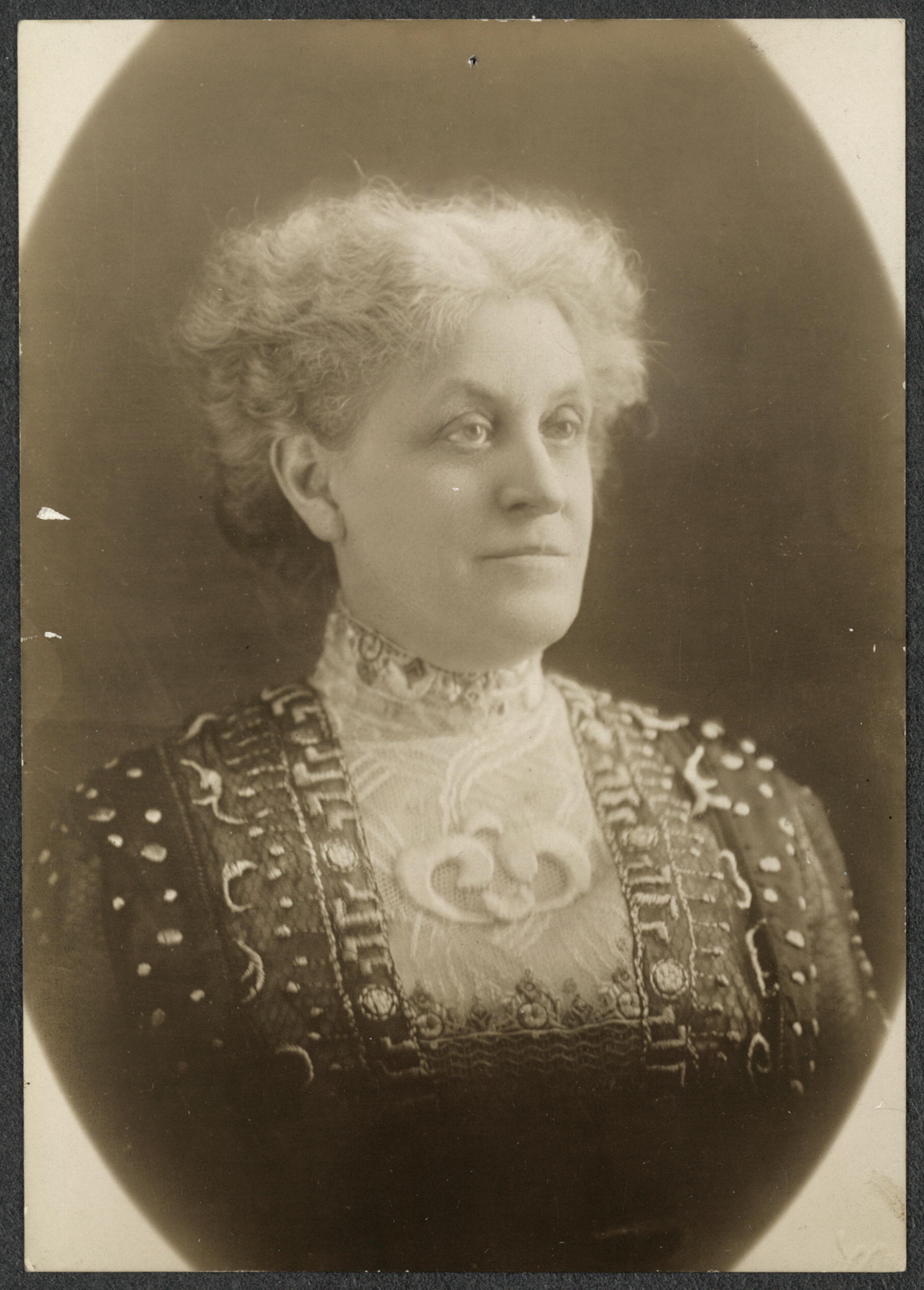
Mrs. Carrie Chapman Catt,
Speaker at Continental Hall

Wilson eventually caved under pressure from these activists and members of the more moderate National American Woman Suffrage Association, led by Carrie Chapman Catt. In early 1919 he began to urge Congress to pass an amendment to the U.S. Constitution granting women the right to vote. Following years of failed attempts, the 19th Amendment finally passed the House of Representatives and the Senate that spring.
A fierce ratification fight followed in state legislatures, leading to the amendment’s enactment into law on August 26, 1920—just in time for women to vote nationwide in that fall’s presidential election.

BIBLIOGRAPHY:
Bausum, Ann. With Courage and Cloth: Winning the Fight for a Woman’s Right to Vote. Washington, D.C.: National Geographic Society, 2004.

Flexner, Eleanor. Century of Struggle: The Woman’s Rights Movement in the United States. Cambridge, Massachusetts: Harvard University Press, 1996 edition, 2000 printing.

Ford, Linda G. Iron-Jawed Angels: The Suffrage Militancy of the National Woman’s Party, 1912-1920. Lanham, Maryland: University of America Press, 1991. See pages 133-34 for specific details regarding the “grand picket.”

Stevens, Doris. Jailed for Freedom. New York, New York: Liveright Publishing Corporation, 1920. See pages 75-79 for specific details regarding the “grand picket.”
ON-LINE RESOURCES:
For more information about blog post author Ann Bausum’s book for young readers: With Courage and Cloth, visit http://www.annbausum.com/courage.html
To learn about her other books of social justice history for young people, visit: http://www.annbausum.com/index.html
For more information about the National Woman’s Party, visit: http://www.sewallbelmont.org/
Watch “Iron Jawed Angels” ( 2004) the HBO dramatization of the closing fight for woman’s suffrage, starring Hilary Swank as National Woman’s Party leader Alice Paul. See this link for details: http://iron-jawed-angels.com/
For the transcript of an extensive interview recorded with Alice Paul during 1972-73 click this link: http://content.cdlib.org/ark:/13030/kt6f59n89c/

See additional images about the 20th-century woman suffrage fight at the on-line American Memory exhibit at the Library of Congress of photos from its National Woman’s Party collection. Use this link:  http://memory.loc.gov/ammem/collections/suffrage/nwp/

Photo credits for all images:
Women of Protest: Photographs from the Records of the National Woman's Party, Manuscript Division, Library of Congress, Washington, D.C.

See this link for more information on rights:
http://memory.loc.gov/ammem/collections/suffrage/nwp/rights.html

Editor's Note:
Ann Bausum writes books about U.S. history for readers young and old, ages 10 and up. Her books help upper elementary, middle school, and high school students discover the drama and significance behind stories from history that may barely be presented in their textbooks. Her goal as an author is to make history relevant, engaging, and alive. Visit her website to find out more about her, her award-winning books, and the process of writing nonfiction.