Friday, March 7, 2014

Women of PURE GRIT Demonstrate Character, Courage, and Commitment

March 7 - Today's post contributed by Mary Cronk Farrell


Seventy-nine American WWII nurses survived combat and three years as POWs of the Japanese, but the story is perhaps best told through the eyes of a single nurse.

Dorothy Scholl was born a hundred years ago, the same year five-thousand suffragists marched to the White House amid much ridicule and abuse by an antagonistic mob.  She grew up far from Pennsylvania Avenue, the ninth child of ten on a farm in Missouri. But she had the independent spirit of a 20th Century woman, and two of Dorothy’s older sisters helped send her to nursing school.
Dorothy Scholl graduated from nursing school in 1936
Photo courtesy of Carolyn Armold Torrence

Dorothy joined the Army in 1940 and the next year sailed to her duty station in Manila, in the lush, tropical Philippine Islands. One of only two women on the transport ship, she quickly caught the eye of 2nd Lieutenant Harold Armold.  Dorothy’s shift at the army hospital, Sternberg, left plenty of free time to explore Luzon Island with Harold and enjoy dates at the fancy Officers Club.

Like most of the nurses and military men, Dorothy had a grand time and couldn’t imagine any country daring to attack America. When the Japanese bombed the Philippines shortly after Pearl Harbor, military and civilian wounded poured in. Dorothy and the other nurses worked eighteen to twenty hours a day, even as bombing raids shook the hospital. Foxholes were dug on the hospital grounds. Nurses tried to keep a sense of humor despite the trauma. During one raid, Dorothy stayed with her patients, but looked up later and saw Harold and a priest in the nearest foxhole. “I couldn’t have gotten in if I had tried,” she said, laughing. She and Harold became engaged in the midst of war.

As the Japanese landed and marched toward Manila, American forces left the city, retreating to the Bataan Peninsula and Corregidor Island. Dorothy and the other army nurses were ordered to retreat with them and set up field hospitals on Bataan.
American Arm Nurses Quarters oat Hospital No. 2,
Bataan Peninsula, Philippines, 1942
Photo from American Defenders of Bataan & Corregidor

The Japanese attack pressed U.S. and Filipino soldiers, soon sending thousands of wounded soldiers to the jungle hospitals. Dorothy thought by joining the Army Nurse Corp, she’d escaped the rough, outdoor life she’d known on the farm. She had no desire to go on a picnic, much less an extended camping trip in the jungle. She hated the snakes, which often hung down from the trees. Medical supplies and food ran short, and soldiers and nurses alike suffered tropical diseases. Conditions worsened as hundreds of dysentery patients tried to make it to open latrines.

The nurses bathed and did their laundry in the shallow river by the hospital. When a LIFE magazine photographer took pictures, Dorothy wrote home to make sure her family knew she was the one in the bathrobe.
Nurses bathe in the Real River which near Hospital No. 2 on the Bataan Peninsula.
Dorothy Scholl is standing on the plank in the flowered robe
(photographer Annalee Whitmore Jacoby Fadiman
)Photo courtesy of Anne Fadiman


After four months of battle nursing, Dorothy and the others were evacuated to Corregidor the night before Bataan surrendered.  Dorothy didn’t know it, but Harold became one of seventy-eight thousand men who would surrender to the Japanese and go on the Bataan Death March.

Corregidor’s underground hospital offered the nurses relief from the bombing raids, but soon Dorothy was too sick with malaria to work. Her birthday, April 29th, was also Japanese Emperor Hirohito’s birthday. Dorothy had no party, but the Japanese celebrated –bombing and shelling Corregidor for twelve hours straight. When Americans surrendered less than a week later, Dorothy was so sick she hardly cared what happened to her.

Now POWs, the women continued nursing after the Japanese shipped them to Santo Tomas Internment Camp in Manila. 1st Lieutenant Josie Nesbit was second in command of the captured army nurses. “We reasoned that if we hoped to remain integrated emotionally, our first and primary duty was to carry on in our most professional capacity -that of nurses,” she said. “Not for one moment did we ever lose sight of the fact that not only were we prisoners of war in every sense, but also that we were U.S. Army Nurses.”

Months of captivity turned into years, prisoners got less and less food, and people began to die of malnutrition. Dorothy knew help was coming in late 1944, as American planes flew overhead and bombed Japanese holdings in Manila.  But the nurses had grown as sick as their patients and feared they might die before they were rescued.


Arm bands Dorothy wore to identify herself
 as a nurse when captured POW by the Japanese
Photo courtesy of Carolyn Armold Torrance

Some had lost more than forty pounds. Josie noticed, “Their eyes gradually sank deeper into hollowed cheekbones. Their gait slowed down more and more as their strength grew less, even their shoulders drooped….”

The night of February 3, 1945, nurses heard shelling in the distance. Dorothy thought the guards seemed nervous. They ordered all the prisoners inside and suddenly the lights went out. Looking out the window, Dorothy saw flares shoot up outside the walls and heard machine gun fire. Then came a loud crash as U.S. tanks crashed through the gates into Santo Tomas.  Prisoners rushed from the building to greet their liberators and the crowd spontaneously broke into singing God Bless America.


Shortly after the liberation of Santo Tomas Internment Camp, February 1945,
 American nurses load into trucks to start their journey home.
Photo from the National Archives

Dorothy was one of the lucky few nurses whose sweetheart survived the Bataan Death March, a prison ship voyage and POW camp in Japan. Throughout her captivity, Dorothy feared Harold was dead, but when she arrived home in the U.S., she learned he was alive. Harold contacted her as soon as he returned to the states that fall and the two were reunited at Fitzsimmons Army Hospital in Colorado, and married November 1, 1945. 

Clipping from Denver Post announces Dorothy's marriage to Harold Armold
Photo courtesy of Carolyn Armold Torrance


Mary Cronk Farrell is the author of PURE GRIT: HOW AMERICAN WWII NURSES SURVIVED BATTLE AND PRISON CAMP IN THE PACIFIC. Find out more about her books at www.MaryCronkFarrell.com.

Wednesday, March 5, 2014

Pass the Band-Aid, please!

March 5 - Today's post contributed by Mary Ann Scheuer and Louise Capizzio

Pass the Band-Aid Please!
Introducing children to Clara Barton, founder of the American Red Cross


The publication of Patricia Polacco’s Clara and Davie (Scholastic, 2014) offers an opportunity to introduce Clara Barton, founder of the American Red Cross. Children will be drawn into Clara’s story, but Polacco focuses on Barton’s childhood. We would like to suggest ways to pair this picture book with more traditional nonfiction sources to give children a fuller picture of Barton’s remarkable life.

Clara and Davie interior1.jpg
We are both youth librarians passionate about sharing engaging nonfiction with children. Mary Ann is a school librarian in a California elementary school. Louise is a youth services manager in a public library in Maine. We hope to share this as an example of one way school and public librarians support each other, sharing titles to further enhance the book options for curious minds.

Mary Ann: Patricia Polacco, one of my favorite authors, draws readers right into Clara and Davie by helping them identify with Clara. One of Polacco’s special gifts as an artist is to connect with her readers because of her ability to convey so many emotions, both in her artwork and her storytelling. Like Polacco herself, Clara was painfully shy as a child and often teased. She found safety and comfort in animals on her farm, often treating them when they were hurt.
“She seemed to have healing in her hands. When Clara was helping animals, her heart sang. She felt brave and confident with critters.”
When her beloved brother Davie was dreadfully hurt falling off the barn roof, Clara tended to him day after day, determined to help him heal, seeing to his wounds and providing comfort and encouragement. My students were fascinated by the historical context of this story, especially how much medical treatment has changed since the 19th century.

Polacco provides only a little information about Barton’s later achievements. She writes in the author’s note, “Clara Barton grew up to become one of the greatest healers and medical practitioners of her time.” Because I want to help my students understand these achievements more fully, I turned to Louise to help recommend other sources for us to explore.

Louise: Introducing Clara Barton to students is exciting because it is a perfect opportunity to reinforce research skills. As always, the best place to start is with a biography. Start elementary students with an overview of Barton’s life and accomplishments: Clara Barton: angel of the battlefield, by the editors of Time for Kids with Anna Prokos. Students will like the clear text and helpful sidebars, with information on topics like “Women’s Rights in the 1800s” and “Civil War Medicine”.


Coming out July 2014 in the very popular Who Was series is Who Was Clara Barton? by Stephanie Spinner. The series is consistent in providing basic information about the subject by incorporating facts and interesting anecdotes in an easy to read text. Sidebars on related materials, a timeline and the black and white illustrations make this series useful for those students who are transitioning into more complex text.

Unfortunately, there are few biographies for an older audience still in print. Hopefully, this will change with the publication of Clara and Davie.

Mary Ann: For older students, visit the National Parks Service website for the Clara Barton National Historic Site in Maryland. They have a Virtual Museum Exhibit, with information from Barton’s life and primary source materials to explore. They even have lesson plans for teachers -- of particular interested is the lesson on Clara Barton that focuses on how she broke boundaries and traditions. Take a look at this interesting Civil War News Souvenir Card from 1863.


Louise: To round out the learning experience, watch and listen to a mini-biography from Biography.com that highlights Barton’s career and accomplishments. Often a video can grab kids’ attention.


Mary Ann Scheuer is an elementary school librarian in Berkeley, CA and writes the blog Great Kid Books. You can also find her on Twitter at @MaryAnnScheuer.

Louise Capizzo is the youth services manager in a public library in Maine and writes the blog The Nonfiction Detectives, along with Cathy Potter. You can also find Louise on Twitter at @Lcapizzo.

Monday, March 3, 2014

Making History - Babe Didrikson Zaharias

March 3 - Today's post contributed by Sandra Neil Wallace

Making History


If you’d asked Babe Didrikson Zaharias about being featured during Women’s History Month, she likely would have said to cross out the words “Women’s” and “Month,” and just talk about her making history. But that’s the very reason why she’s being celebrated: for her irascible drive, for establishing women’s professional sports, and for her records.

Babe never stopped “poking the record books full of holes.” She didn’t quit achieving greatness in the sports world until she lost her most significant battle—to cancer. Even then, Babe reinvented how we approached the disease, treating it as a foe and coining the phrase “cancer fight.”

Babe also shot to smithereens the idea of what femininity meant regarding a female athlete. All Babe needed was one week for the world to witness her brash talk and how she could more than back it up with gold medals in the hurdles and javelin, plus a silver in the high jump. She became the star of the 1932 Olympic Games.

Babe could sew but also brag, hit a golf ball as far as any man, play championship basketball, strike out Joe DiMaggio, and set the world record in the baseball throw (which still stands). At first, sportswriters loved the copy Babe provided, but then the male press corps turned vicious. And though it seems counterintuitive today, women’s athletic associations didn’t like Babe’s success one bit either.

What made Babe tolerate the adversity was her unshakable self esteem. She believed she was the greatest athlete in the world, and no one could change her mind. In researching Babe Conquers the World (Calkins Creek, 2014) we delved into her personal letters, interviews with many people who knew her, and the archives of the newspapers and magazines that covered her brilliant sports career.

Babe faced obstacles that would be insurmountable for many of us: poverty, supporting her family at age 18, riding donkeys and barnstorming the country solo to become a professional athlete, reading headlines and gym posters warning girls not to be a “muscle moll” like Babe. Being called an “it.”

These challenges only fueled Babe to make lofty predictions, then deliver under the glaring spotlight of the press box, where the mostly male contingent rooted for her to fail. Like all great women who challenge and accomplish great things, Babe was a threat to male dominance.

But Babe didn’t have the future of other women in mind when she created the LPGA. She became a professional and golf-circuit founder to experience what she knew all along--that she was a great athlete.

It was only when Babe was diagnosed with cancer (twice) that she found a higher purpose. Thousands of letters poured in from other cancer patients telling her how much hope she brought them, and Babe grew determined to break records on behalf of all cancer survivors. When Babe won the U.S. Open golf title less than a year after her body-altering surgery, she single-handedly changed the world’s outlook on the disease.

Many of us in sports owe our careers to Babe’s pioneering spirit. As a sportscaster, I would have loved to have interviewed Babe. And I suppose Babe Conquers the World is my way of thanking Babe for being courageous, so women like me could be courageous, too. But Babe’s trash-talking and loud-mouth bravado have been silent for nearly six decades. The fact that most girls and women athletes have no idea who she is, what she accomplished, and how it affects them, makes Women’s History Month so important. My co-author (and husband) Rich Wallace and I are proud to have Babe Conquers the World released this month.


Sandra Neil Wallace is a former ESPN sportscaster and the author of two acclaimed novels published by Random House/Knopf: Little Joe, a South Carolina Children’s Book Award finalist, and Muckers, a Booklist Bookends Best Book of 2013. Visit www.sandraneilwallace.com 

Saturday, March 1, 2014

Women's history all year long

March 1 - Today's post contributed by Margo Tanenbaum and Lisa Taylor
Welcome to the fourth annual celebration of women's history in literature for young people!

This year, to ensure that each post receives the attention it deserves, we'll be adding posts on Mondays, Wednesdays, and Fridays (though we reserve the right to sneak in an extra if necessary).  Posts will feature insightful essays from authors, illustrators, librarians and book bloggers. Most will feature great new or upcoming books!See the list of this year's participants in the sidebar.

Please, follow us, check back often, and use the site as a resource for including women's history
 in your libraries, homes, and classrooms all year long.

To start you off, here are a few of our suggestions for doing just that!

Books that have been featured on KidLit Celebrates Women's History Month will link back to the appropriate post(s).

January

Zora Neale Hurston's birth date is January 7.  A writer and anthropologist, she collected southern folktales, many which were adapted for younger children by Joyce Carol Thomas.  Add a tale from What's the Hurry, Fox?: and other animal stories (Harper Collins, 2004) to your storytime.  Explain Hurston's role in preserving these stories.

February

George Washington's birthday is February 22nd.  Share the story of how First Lady, Dolley Madison, saved one of the most iconic paintings of George Washington when British forces sacked and burned the White House in 1814, Dolley Madison Saves George Washington by Don Brown. (Houghton Mifflin, 2007)
The Gilbert Stuart portrait of
George Washington  saved by Dolley Madison.
(public domain artwork from the White House Collection)

March

Of course March is Women's History Month.  Peruse this blog, or search its Index to find innumerable suggestions for sharing great books and information.


April


April is National Poetry Month
.  Read Emily and Carlo by Marty Rhodes Figley aloud, or suggest The Bronte Sisters: The Brief Lives of Charlotte, Emily and Anne, by Catherine Reef. Share Phillis Sings Out Freedom by Ann Malaspina or Phillis' Big Test by Catherine Clinton. Read Liberty's Voice: The Story of Emma Lazarus by Erica Silverman.  These are just a few books about female poets that have been shared on KidLit Celebrates Women's History Month.

Don't neglect living poets!  Read a book by Mary Ann Hoberman, who made history by becoming the United States' second Children's Poet Laureate, and its first female Children's Poet Laureate.


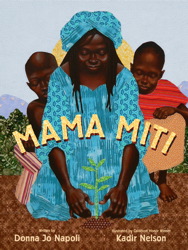
April is also host to Arbor Day, a perfect day to share a book about Wangari Maatthai. Try Donna Jo Napoli's Mama Miti.

Earth Day is in April, too.  How about Rachel Carson and her Book that Changed the World by Laurie Lawlor?

April is also National Autism Awareness Month.  You'd be hard-pressed to find a better autism spokesperson than Temple Grandin. Booktalk or suggest Temple Grandin: How the Girl who Loved Cows Embraced Autism and Changed the World, by Sy Montgomery.


Jazz Appreciation Month - also in April. Try Skit-Skat Raggedy Cat: Ella Fitzgerald by Roxanne Orgill or The Sweethearts of Rhythm: The Story of the Greatest All-Girl Swing Band in the World by Marilyn Nelson.


May

On May 5, 1864, Nellie Bly was born. A woman in a man's world, she was a globetrotting reporter - breaking new ground in travel, reporting , and social mores. In short, she was a world-wide phenomenon. The Daring Nelly Bly: America's Star Reporter (Dragonfly, 2009) by Bonnie Christensen, is a picture book biography suitable for sharing aloud.

On May 21, 1932, Amelia Earhart became the first woman to complete a solo transatlantic flight by flying 2,026 miles from Newfoundland to Ireland. Commemorate the day with a reading of Night Flight: Amelia Earhart Crosses the Atlantic (Simon & Schuster, 2011).


June

June 23, 1972 was a milestone in the modern fight for equal rights. It is the day that Title IX of the Education Amendments of 1972, was signed into law. This legislation guarantees equal access and equal opportunity for females in almost all aspects of our educational systems.  If you interact with older girls (especially athletes), be sure they're aware of Karen Blumenthal's landmark book, Let Me Play: The Story of Title IX: The Law that Changed the Future of Girls in America.

July

July 2 is the anniversary of Amelia Earhart's plane being lost in the Pacific Ocean.  Learn about Amelia through Amelia Lost: The Life and Disappearance of Amelia Earhart, by Candace Fleming, or one of the many other books about this iconic figure in women's history.

For the Fourth of July, learn about our founding mothers in Founding Mothers: Remembering the Ladies, by Cokie Roberts.


Celebrate the anniversary of the founding of Fanny Farmer's School of Cookery in Boston (August 23, 1902) by reading Fannie in the Kitchen:  the Whole Story from Soup to Nuts of How Fanny Farmer Invented Recipes with Precise Measurements, by Deborah Hopkinson (recently re-issued in e-book!)


For Library Card Sign-up Month, read about one of the first children's librarians, Anne Carroll Moore, in Miss Moore Thought Otherwise by Jan Pinborough.

Hispanic Heritage Month (Sep 15-Oct 15) provides an opportunity to learn about notable Hispanic women such as Sonia Sotomayor, our first Hispanic Supreme Court justice.  Check out Sonia Sotomayor:  a Judge Grows in the Bronx, by Jonah Winter.  Or read about labor activist Dolores Huerta in Dolores Huerta: a Hero to Migrant Workers, by Sarah E. Warren.


October

Fire Prevention Week is an opportune time to read Molly, by Golly! : The Legend of Molly Williams, America's First Female Firefighter by Diane Ochiltree (Calkins Creek, 2012).

Celebrate the birthday of Eleanor Roosevelt (October 11) by reading the newest children's book about her by Leslie Kimmelman, Hot Dog! Eleanor Roosevelt Throws a Picnic.

See Eleanor, bottom left, with hot dog!


November

Celebrate Native American Heritage Month by reading about Native American woman--beyond Pocahontas and Sacajawea.  Try She Sang Promise by Jan Godown Annino, Red Bird Sings, by Gina Capaldi, or Native Women of Courage, by Kelly Fournel.


Celebrate the birthdays of:  Elizabeth Cady Stanton (November 12) with Elizabeth Leads the Way: Elizabeth Cady Stanton and the Right to Vote by Tanya Lee Stone; Civil War surgeon Mary Walker (November 26) with Mary Walker Wears the Pants:  The True Story of the Doctor, Reformer, and Civil War Hero by Cheryl Harness; and beloved author Louisa May Alcott (November 29) with Louisa May's Battle  How the Civil War Led to Little Women, by Kathleen Krull.

Thanksgiving is a perfect time to share Thank you Sarah:  The Woman who Saved Thanksgiving, by Kathleen Krull, about Sarah Hale's campaign to have Thanksgiving recognized as a federal holiday.

December

In addition to celebrating Christmas, Hanukkah, and/or Kwanzaa, think about celebrating Human Rights Month by reading about labor activist Clara Lemlich in Brave Girl:  Clara and the Shirtwaist Makers' Strike of 1909.

Wyoming was the first territory to give women the right to vote (December 10, 1869).  Read I Could Do That! Esther Morris Gets Women the Vote, by Linda Arms White.


This is a collaborative site.  Please add your comments and suggestions!  We hope you like our new look!